When a Game Displays Images That Should Not Be There
A game may continue running while the screen fills with flashing triangles, colored squares, stretched textures, black patches, or objects that seem to extend across the entire scene. In other cases, the corruption appears for only a fraction of a second before disappearing. These visual errors are often described as GPU artifacting, although the graphics processor itself is not always the only possible cause.
Modern games place several parts of a graphics card under load at the same time. The graphics processor performs calculations, video memory stores textures and frame data, power circuitry supplies rapidly changing electrical demands, and the cooling system removes the heat produced during operation. A problem within any part of that process can affect the image before it reaches the monitor.
Artifacting should not be judged by appearance alone. A failing graphics card can create visual corruption, but similar symptoms can also result from unstable overclocking, excessive temperature, damaged video memory, driver problems, inadequate power delivery, or errors within a particular game. Careful observation is necessary before assuming that the graphics card must be replaced.
What GPU Artifacting Looks Like
Artifacting is a broad description rather than one single visual pattern. The appearance depends on the information being processed incorrectly and the point at which the error enters the rendering process. Some artifacts are subtle enough to resemble a game defect, while others make the image nearly impossible to understand.
Frequently reported visual symptoms include:
- Small colored dots or blocks appearing across the image
- Textures flashing between normal and incorrect colors
- Long triangles stretching outward from characters or objects
- Checkerboard patterns appearing on surfaces
- Black shapes covering portions of the game environment
- Objects flickering, disappearing, or rendering in the wrong position
- Horizontal or vertical lines that appear only under graphical load
- Sudden bursts of visual corruption immediately before a crash
The same computer may display more than one of these symptoms. For example, a game may begin with occasional colored specks and later develop stretched geometry as the graphics card becomes warmer. Another computer may show corrupted textures for several minutes before the game closes or the display goes black.
Artifacts Are Different From Ordinary Screen Tearing
Screen tearing is sometimes mistaken for artifacting. Tearing usually appears as a horizontal split where different portions of two frames are visible at the same time. It occurs when the graphics card and monitor are not presenting frames in synchronization. Although distracting, tearing does not normally mean that image data has been corrupted.
Artifacting changes the content of the image itself. Colors, textures, geometry, or individual pixels appear incorrectly because information has been processed, stored, or delivered improperly. The distinction matters because changing synchronization settings may reduce screen tearing, but it will not repair unstable video memory or a graphics card that is overheating.
| Visual behavior | Likely description | Typical pattern |
|---|---|---|
| Horizontal image split | Screen tearing | Parts of separate frames appear together |
| Colored blocks or random pixels | Possible artifacting | Image data appears corrupted |
| Brief full-screen flicker | Display signal or rendering issue | The entire picture flashes or disappears |
| Stretched shapes and broken objects | Possible geometry artifacting | Game objects extend or render incorrectly |
| Blur during rapid movement | Motion blur or display response behavior | Moving objects lose clarity |
These descriptions are useful starting points, but they are not final diagnoses. More than one issue can occur at the same time, and a failing graphics card may produce different symptoms as its temperature or workload changes.
The Role of the Graphics Processor
The graphics processing unit, or GPU, performs the calculations needed to build each frame displayed during a game. It handles lighting, shadows, object geometry, visual effects, and many other operations. A modern game may require billions of calculations while also changing its workload from one moment to the next.
When the processor is stable, these calculations produce consistent results. If the GPU becomes electrically unstable, overheats, or is pushed beyond a reliable clock speed, some calculations may be completed incorrectly. The resulting frame can contain misplaced shapes, incorrect colors, or other visible errors.
This is one reason artifacting may appear only during demanding games. Basic desktop use, web browsing, and video playback may not place enough load on the graphics processor to expose the problem. A computer can therefore seem perfectly normal until a game, rendering program, or graphics benchmark increases power consumption and temperature.
Video Memory Can Produce Its Own Visual Symptoms
A graphics card also contains dedicated video memory, commonly called VRAM. This memory stores textures, frame buffers, depth information, and other data needed during rendering. The GPU repeatedly reads from and writes to this memory while a game is running.
If stored data becomes corrupted, the GPU may receive incorrect information even when its own calculations are functioning properly. A damaged texture in memory can appear as a strangely colored surface, a repeating pattern, or a section of an object that looks completely different from the rest of the scene.
Video memory problems can be difficult to separate from GPU core problems through appearance alone. Certain patterns may suggest memory corruption, but a reliable diagnosis usually requires comparing behavior across several games, temperatures, workloads, and graphics settings.
A Problem Limited to One Game May Not Be Hardware Failure
Not every visual defect points to damaged hardware. Games are complex programs, and errors can be introduced by an update, an incompatible graphics setting, a corrupted shader cache, or a problem with a specific driver version. If the corruption appears in only one game while every other graphics workload remains stable, the game itself deserves closer attention.
Useful details include whether the issue began after a game update, whether it appears in the same location each time, and whether other players report the same visual defect. A repeatable texture error affecting one object or one level may be part of the game rather than a sign that the graphics card is failing.
Hardware-related artifacting is more likely to appear across multiple demanding applications, change as the graphics card warms up, or become worse as graphical load increases. Even then, testing should continue before reaching a final conclusion.
Heat Can Turn a Stable Graphics Card Into an Unstable One
A graphics card may operate normally when first powered on and begin showing artifacts only after several minutes of gaming. That delay often points toward temperature, although heat is not the only possible explanation. As the card warms, the GPU, video memory, power components, and circuit board all experience changing electrical and physical conditions.
Cooling performance depends on more than whether the fans are spinning. Dust packed into the heatsink, dried thermal compound, worn thermal pads, restricted case airflow, or a fan that no longer reaches its intended speed can allow temperatures to rise even though the cooling system appears active.
Temperature-related instability may follow a recognizable pattern:
- The game starts and displays normally.
- GPU load and temperature increase.
- Small flashes, dots, or texture errors begin to appear.
- The corruption becomes more frequent or more severe.
- The game freezes, closes, or the display driver resets.
If the same sequence occurs repeatedly, temperature should be investigated. However, a high reading alone does not prove the card is defective. Different graphics cards have different operating ranges, and the location of the temperature sensor may not reveal the condition of every memory chip or power component.
Overclocking Can Create Errors Without Permanent Damage
Graphics cards are designed to operate within tested frequency and voltage ranges. Increasing the GPU or memory clock can improve performance, but it also reduces the margin for error. A setting that appears stable in one game may fail in another because each workload stresses the hardware differently.
Memory overclocking often produces visual corruption before the entire computer becomes unstable. Colored dots, flashing textures, checkerboard patterns, or brief blocks can appear while the game continues running. An unstable GPU core clock may be more likely to produce stretched geometry, driver crashes, freezes, or sudden black screens, although there is no universal pattern.
Factory-overclocked graphics cards can also become unstable over time. A card may have operated at its original settings for years before aging components, higher temperatures, or changes in workload reduce its remaining stability margin. Returning the card to standard clock values can help determine whether the issue is related to operating frequency rather than immediate hardware failure.
Power Delivery Problems Can Affect Rendering Stability
A gaming graphics card can draw considerably more power under load than it does while the computer is sitting at the desktop. The power supply, PCI Express slot, graphics card connectors, cables, and onboard voltage regulation must all respond to these changing demands.
If power delivery becomes unstable, the card may not receive consistent voltage when load increases. The result can include visual corruption, sudden driver resets, black screens, game crashes, or a complete system restart. These symptoms may resemble a failing GPU even when the graphics processor itself is not damaged.
Several conditions deserve attention during diagnosis:
- A graphics card power connector that is not fully seated
- A damaged or overheated cable terminal
- An adapter used outside its intended capacity
- A power supply that is undersized, aging, or unstable under load
- Multiple high-draw connectors sharing a cable where separate cables are recommended
- Poor contact between the graphics card and the motherboard slot
Power problems do not always create visible artifacts first. Some systems shut down or restart before corrupted frames remain on the screen long enough to be noticed. Others continue operating while the graphics card repeatedly loses and regains stability.
Driver Problems and Hardware Problems Can Look Similar
The graphics driver controls communication between the operating system, games, and graphics hardware. A defective driver release, incomplete update, corrupted installation, or conflict with older driver components can produce rendering errors that resemble hardware instability.
Driver-related corruption often begins after a software change. The timing may be more informative than the appearance of the artifact itself. If several games worked correctly before a driver update and then developed similar problems immediately afterward, the software change deserves investigation before the card is condemned.
Hardware problems are often less predictable. They may change with temperature, load, clock speed, or physical movement. A damaged card may also behave differently from one startup to the next. Still, no single behavior creates a perfect dividing line between software and hardware.
| Observation | What it may suggest |
|---|---|
| Problem begins immediately after a driver update | Driver compatibility or installation issue |
| Artifacts appear only after the card becomes hot | Cooling or temperature-sensitive instability |
| Corruption appears in several unrelated games | Broader graphics instability |
| One game shows the same defect in the same place | Game-specific rendering problem |
| Lowering memory speed reduces colored blocks | Possible video memory instability |
| The computer restarts under heavy GPU load | Power delivery or severe hardware instability |
These observations help narrow the possibilities, but they should be treated as evidence rather than proof. Reliable diagnosis comes from comparing multiple tests and looking for repeatable patterns.
The Monitor and Video Cable Should Not Be Ignored
Not every abnormal image begins inside the graphics card. A damaged DisplayPort or HDMI cable can create sparkles, brief dropouts, color shifts, horizontal noise, or intermittent loss of signal. A monitor with an internal fault can also display lines, flickering, or sections of corrupted color.
Cable and monitor problems usually affect the final signal rather than the game’s rendered geometry. They are less likely to create stretched characters, broken textures, or objects extending across the scene. Even so, simple display-path checks can prevent unnecessary replacement of expensive graphics hardware.
Testing with another cable, another monitor input, or a different display can reveal whether the problem follows the computer or remains with the external display equipment. Capturing a screenshot can also provide a useful clue. If the corruption appears inside the saved screenshot, the error was likely present before the image reached the monitor. If the screenshot looks normal while the physical screen looks corrupted, the cable, display, or signal path may deserve greater attention.
Artifacting at Startup Changes the Diagnosis
Visual corruption that appears before a game opens is more concerning than a defect limited to one application. If colored blocks, lines, or broken characters appear during the motherboard logo, firmware screen, or initial startup display, the operating system and game software are not yet controlling the image.
Pre-boot artifacting can indicate a problem with the graphics card, video memory, connection, or display path. It does not automatically identify the failed component, but it makes a game-specific cause much less likely.
A card that shows corruption before the driver loads may still reach the desktop, especially if the operating system later switches to a basic display mode. In other cases, the computer may stop displaying an image once the full graphics driver attempts to initialize the card.
Intermittent Problems Require Pattern Tracking
Intermittent artifacting can be more difficult to diagnose than a card that fails consistently. The computer may pass a short test, run normally for several days, and then produce corruption during a particular game or room temperature.
Keeping a basic record can reveal relationships that are easy to overlook. Useful notes include:
- The game or application running when the issue appeared
- The amount of time the computer had been under load
- GPU and memory temperature readings when available
- Whether the card was overclocked or using default settings
- The graphics driver version
- Whether the problem appeared in a screenshot or recording
- Whether a restart temporarily restored normal operation
- Any recent changes to cables, hardware, drivers, or game settings
A single incident may not provide enough information, but repeated observations often reveal whether the problem follows temperature, workload, software changes, or a particular display connection.
Testing Should Begin With the Least Invasive Changes
When artifacting appears, the safest approach is to begin with simple checks that do not involve disassembling the graphics card. Replacing expensive hardware too early can waste money, while aggressive testing on an unstable card can sometimes make the problem more difficult to evaluate.
A practical sequence is to return the graphics card to standard clock settings, verify that power connectors are fully seated, check temperatures under load, and compare behavior across more than one game. Updating or reinstalling the graphics driver may also be appropriate when the timing suggests a software-related problem.
Changing only one condition at a time is important. If the driver, cable, game settings, clock speeds, and power connections are all changed together, it becomes difficult to identify which adjustment affected the result.
Reducing Graphics Load Can Reveal Useful Clues
Lowering the workload does not repair damaged hardware, but it can show whether the corruption is related to load, temperature, or memory usage. Reducing resolution, texture quality, ray tracing, or frame rate may allow the card to operate with less power and heat.
If artifacting disappears only after texture quality is reduced, video memory usage may deserve closer attention. If limiting the frame rate prevents corruption, the lower power draw or reduced temperature may be helping the card remain stable. These results are clues rather than permanent solutions.
A graphics card that functions only under reduced settings may still be useful temporarily, but the change should not be mistaken for a complete repair. The underlying instability may continue to worsen, especially if it is caused by aging memory, weakened solder connections, or deteriorating power components.
Stress Tests Must Be Used Carefully
Graphics stress tests can help reproduce artifacting under controlled conditions. They may reveal whether the problem appears only after a certain temperature, power level, or amount of time. However, a stress test places sustained load on hardware that may already be unstable.
Testing should be stopped if temperatures rise beyond a reasonable range, the display becomes heavily corrupted, the card begins losing signal, or the computer repeatedly restarts. Continuing a severe test after obvious failure appears rarely provides useful additional information.
A card passing one short benchmark does not prove that it is healthy. Some faults appear only during certain memory patterns, rendering methods, or power transitions. Conversely, a crash during one demanding test does not automatically prove physical failure if the driver, overclock, or software environment is unstable.
When Cleaning and Cooling Service May Help
If artifacting follows a clear temperature pattern, cooling service may improve stability. Dust removal, fan inspection, thermal compound replacement, and thermal pad evaluation can restore heat transfer when the original cooling system has deteriorated.
Cooling work must be performed carefully. Graphics cards often use thermal pads of specific thicknesses, and replacing them with incorrect materials can prevent the heatsink from contacting the GPU properly. Excessive force, missing screws, or uneven mounting pressure can also create new problems.
Cooling service is most useful when the hardware remains electrically healthy and the instability is caused by excessive temperature. It cannot restore damaged memory cells, repair a failing GPU core, or correct burned power circuitry.
Physical Damage Is Not Always Visible
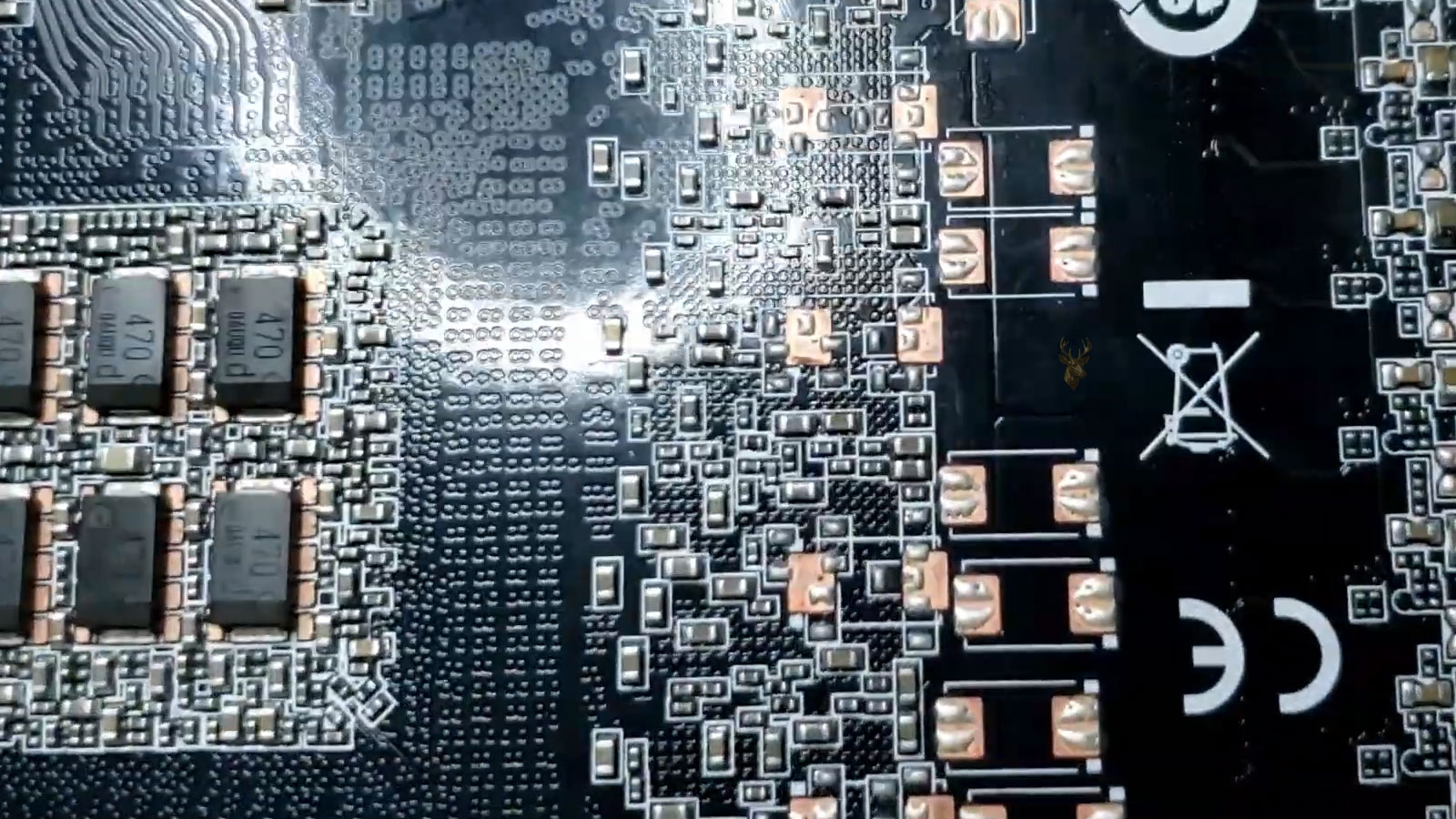
A graphics card can look clean and undamaged while still containing a serious internal fault. Memory chips, solder connections, voltage regulators, and microscopic circuit paths may fail without leaving obvious burn marks or discoloration.
Large graphics cards also place considerable weight on the motherboard slot. Repeated movement, poor support, rough transportation, or long-term sag can stress the connector and circuit board. A card that changes behavior when moved or reseated may have a contact problem, cracked solder joint, or damaged slot connection.
Visible inspection remains worthwhile, especially when looking for damaged connectors, missing components, corrosion, fan obstruction, or overheated cable terminals. A normal appearance, however, should never be treated as proof that the card is electrically sound.
Repair, Replacement, and Practical Limits
The appropriate next step depends on the age, value, and failure type of the graphics card. Some problems can be corrected through cleaning, cooling service, connector repair, or power-delivery work. Others involve faults inside the GPU or video memory that are difficult or uneconomical to repair.
Before deciding, it helps to consider several factors:
- Whether the fault has been isolated to the graphics card
- The cost of a comparable replacement
- The age and performance level of the existing card
- Whether replacement parts are available
- The likelihood that the repair will remain reliable
- Whether the rest of the computer can support a newer card
A high-value graphics card with a repairable power or connector fault may justify board-level service. An older entry-level card with failing video memory may be more practical to replace. The decision should be based on confirmed findings rather than the visual symptom alone.
Protecting Saved Games and Important Files
Artifacting usually affects graphics output rather than personal files, but repeated crashes and forced shutdowns can still create secondary problems. A system that freezes during disk activity may damage open files, game settings, or application data.
Important documents, photographs, project files, and local game saves should be backed up before extensive troubleshooting continues. This is especially important when the computer also restarts unexpectedly, loses power, or becomes unstable outside of games.
Cloud synchronization can protect some game progress, but not every title stores all settings and saves online. Confirming where a game keeps its local data can prevent unnecessary loss if the system later requires repair, replacement, or operating system service.
Reading the Pattern Instead of Guessing
GPU artifacting is a symptom with several possible causes. Heat, unstable clock speeds, damaged video memory, driver problems, power delivery, game defects, cables, and display hardware can all create abnormal images. The most useful evidence comes from when the corruption appears, where it appears, and what changes its behavior.
Artifacts limited to one game may point toward software. Corruption across several demanding applications raises greater concern about hardware. Problems that worsen with temperature suggest a cooling or temperature-sensitive fault, while visual errors present before the operating system loads make game software much less likely.
A careful diagnosis avoids replacing a graphics card based only on a few colored blocks or one crashing game. By comparing workloads, temperatures, screenshots, cables, settings, and power conditions, the problem can be narrowed to the part of the system most likely responsible.
Keeping a Gaming Computer Reliable
Stable gaming performance depends on more than the graphics card model. Clean airflow, reliable power, secure connections, appropriate clock settings, and reasonable temperatures all contribute to consistent rendering. Small warning signs should be observed rather than ignored, particularly when they become more frequent under load.
Visual corruption does not always mean that a graphics card has reached the end of its life, but it does indicate that part of the rendering or display process is no longer operating as expected. Identifying the pattern early provides the best chance of correcting a cooling, software, connection, or power problem before the instability becomes more severe.