A Game Can Begin Stuttering Even When the Hardware Has Not Failed
A PC game that previously ran smoothly may begin pausing, hitching, or producing uneven frame delivery after a game update, graphics-driver installation, hardware change, or cache cleanup. The computer may still reach its expected frame rate during less demanding scenes, yet brief interruptions appear whenever a new effect, environment, character, or object enters the screen.
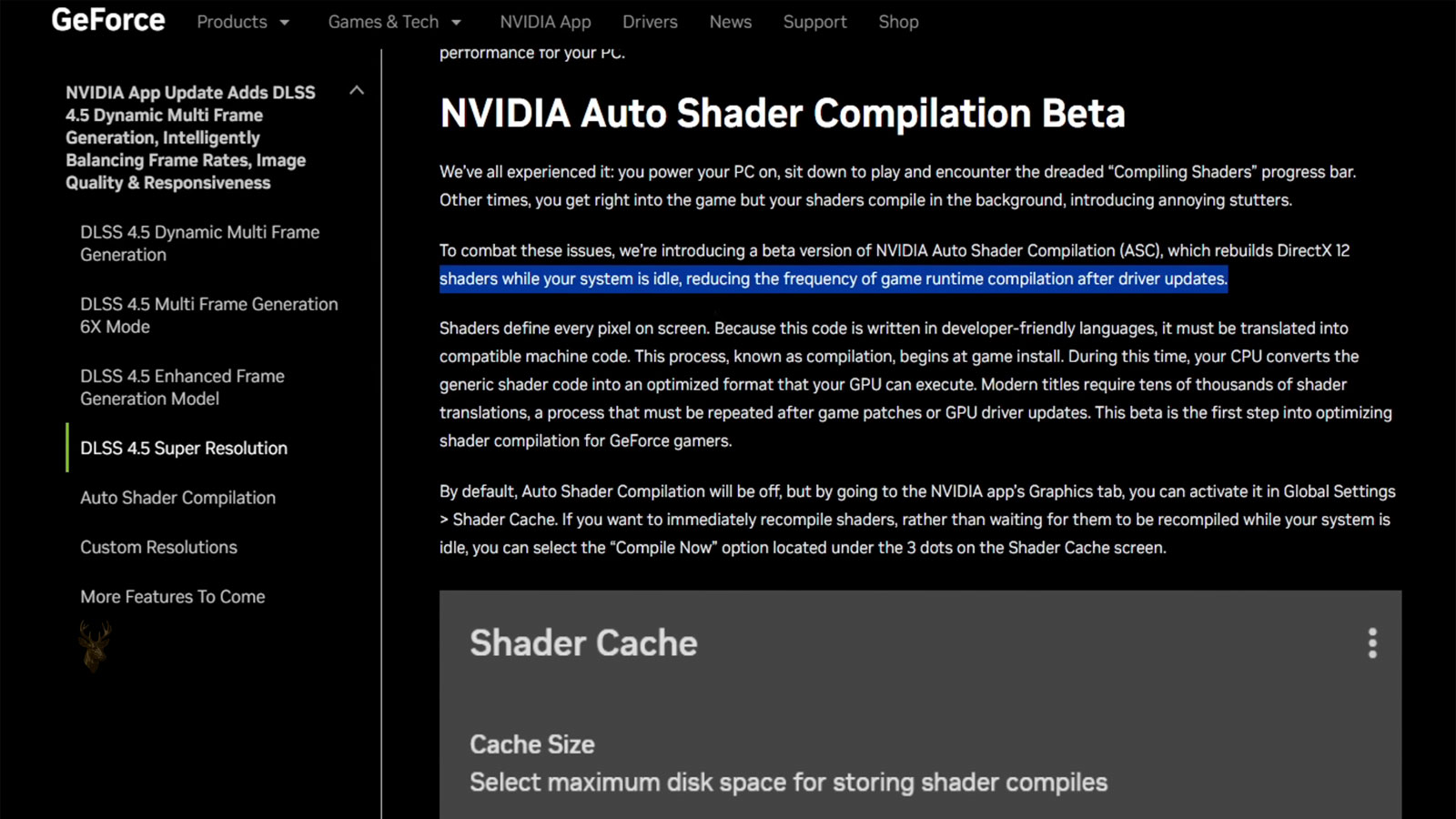
These interruptions are sometimes caused by shader compilation. Modern games use many small graphics programs called shaders to determine how surfaces, lighting, shadows, particles, reflections, transparency, and other visual effects should be rendered by the graphics processor.
The game or graphics driver may compile these shaders into a form suited to the installed graphics hardware and current software environment. When the resulting cache is missing, outdated, incompatible, or damaged, some of that work may need to be performed again while the game is running.
A temporary pause during a new visual effect can come from graphics preparation rather than insufficient average frame rate.
Shaders Are Small Programs Executed by the Graphics Processor
A three-dimensional scene contains geometry, textures, materials, lights, shadows, reflections, particles, and post-processing effects. The graphics processor must apply instructions that determine how these elements should appear in the final image.
Those instructions are commonly handled through shaders. Different shader stages can influence the position of geometry, the appearance of pixels, the movement of particles, the handling of lighting, and many other rendering operations.
A complex game may contain thousands of shader combinations. The required combination can change according to the location, material, weather, character equipment, graphics setting, lighting condition, and special effect currently visible.
The graphics processor does not simply display textures; it follows programs that determine how the entire scene is constructed and shaded.
Shader Source Code Is Not Always Used Directly by the GPU
Game developers create shader instructions through graphics programming languages and rendering systems. Those instructions may need to be translated, optimized, and prepared for the graphics architecture and driver installed in the computer.
This preparation process is broadly described as compilation. The result is more suitable for execution by the graphics processor than the original high-level shader instructions.
Compilation can occur before the game begins, during a loading screen, when a level opens, or while a new effect is encountered during gameplay. The method depends on the game engine, graphics interface, driver, platform, and developer implementation.
The Shader Cache Stores Work That Has Already Been Completed
Repeatedly compiling the same shader can waste time and processing resources. A shader cache stores previously prepared results so they can be reused during later sessions.
The game, graphics driver, operating system, launcher, or game engine may maintain its own cache. A computer can therefore contain several separate collections of shader-related data rather than one universal shader folder.
When the correct cached result is available, the game can load it instead of rebuilding the shader at the moment it is needed. This can reduce pauses and produce more consistent frame delivery.
Cached Shaders Are Reusable but Not Permanent
The stored result may become unusable after changes to the game, driver, graphics hardware, rendering configuration, or cache format.
Shader Compilation Stutter Is Different From Consistently Low Performance
A graphics card that cannot render a scene quickly enough may produce a consistently low frame rate. Shader compilation stutter more often appears as a brief pause or sharp increase in frame time when the game encounters a shader combination that has not yet been prepared.
The game may run smoothly before and after the interruption. Returning to the same location or triggering the same visual effect again may produce less stutter because the required shader has now been compiled and cached.
This behavior can make the computer appear powerful enough and unstable at the same time. The average frame-rate counter may remain high even though occasional long frames make movement feel uneven.
| Observed Behavior | More Consistent With Shader Compilation | More Consistent With General Performance Limits |
|---|---|---|
| Brief pause when a new effect first appears | Common | Possible, but usually part of broader slowdown |
| Same scene becomes smoother on a second visit | Common after the shader has been cached | Less likely unless background load also changed |
| Frame rate remains low throughout demanding areas | Not the typical pattern by itself | Common with insufficient GPU or CPU performance |
| Stutter returns after a driver or game update | Common when cached data becomes invalid | Possible if the update increased graphical demand |
| Reducing resolution greatly improves the problem | May have limited effect on compilation pauses | Often improves a GPU performance limitation |
| Frame-time graph shows isolated large spikes | Common during runtime compilation | Can also occur from storage, CPU, memory, or background activity |
The pattern can suggest shader compilation, but it does not prove it. Storage access, processor scheduling, memory pressure, thermal throttling, background software, network delays, and game-engine problems can create similar frame-time spikes.
Frame Time Reveals Interruptions That Average Frame Rate Can Hide
Frame rate measures how many frames are produced during a period of time. Frame time measures how long each individual frame takes to complete. Two gameplay sessions can report the same average frame rate while feeling very different because their frame times are distributed differently.
A mostly smooth sequence interrupted by a few unusually long frames may still produce a respectable average. The player notices the interruptions as hitching, delayed input response, or uneven camera movement.
Shader compilation often appears as isolated frame-time spikes rather than a continuous reduction in performance. A detailed frame-time graph can therefore be more informative than an average frame-rate number.
A high average frame rate does not prevent one abnormally slow frame from being visible to the player.
A Game Update Can Invalidate Previously Compiled Shaders
A game update can change shader code, rendering features, materials, lighting systems, graphics settings, or the engine version. Cached results prepared for the previous version may no longer match the updated game.
The game may delete the old cache automatically, ignore entries that are no longer compatible, or rebuild portions as they are encountered. The first session after the update can therefore feel less consistent than later sessions.
A small update can still affect many shaders if it changes a shared rendering component used throughout the game. The download size alone does not reveal how much shader preparation will be required afterward.
Major Graphics Updates Can Change the Rendering Pipeline
Some updates introduce a new lighting system, ray-tracing option, upscaling method, anti-aliasing technique, or graphics interface. These changes can alter the combinations of shaders required by many scenes.
A game that previously had a complete cache may suddenly need to prepare a substantially different set. This is not necessarily evidence that the update damaged the computer.
The first launch may include a dedicated shader-compilation screen. Other games perform part of the work during loading and leave the remaining combinations to be prepared during play.
A visual upgrade can require the game to rebuild the instructions used to render many existing locations.
Graphics-Driver Updates Can Also Reset or Replace Shader Data
The graphics driver translates requests from the game and operating system into work that the GPU can execute. A driver update may change compilation behavior, optimizations, cache formats, compatibility rules, or storage locations.
Previously cached shader data may be removed during installation or treated as incompatible with the new driver. Games that were smooth before the update can briefly rebuild their caches afterward.
This does not mean every new driver should be avoided. Driver updates can correct game crashes, rendering errors, security problems, and performance limitations. Temporary shader rebuilding must be distinguished from a persistent driver defect.
A Clean Driver Installation Commonly Removes Existing Caches
A clean driver installation removes more previous driver information than a normal update. This can be useful when correcting damaged settings or inconsistent driver components, but it may also remove shader caches that were built over many gaming sessions.
Afterward, several games may stutter during their first encounters with effects that had previously been cached. The behavior can improve as each title recreates the required data.
If the stutter remains unchanged after repeated sessions through the same areas, the cause may extend beyond the expected cache rebuild.
Removing old driver data can solve one problem while temporarily discarding performance data that games had already prepared.
Changing the Graphics Card Requires New Hardware-Specific Preparation
Compiled shader data may depend on the graphics architecture and driver used when it was created. Replacing the graphics card can make the existing cache unsuitable for the new hardware.
A game may therefore rebuild shaders after an upgrade even when both graphics cards come from the same manufacturer. A different model or generation can require different optimization and instruction choices.
Initial stutter after a graphics-card replacement should be evaluated over repeated gameplay. Persistent problems may instead involve driver remnants, power delivery, thermal conditions, processor limits, or game settings carried over from the previous hardware.
Moving a Game to Another Computer Does Not Always Move Its Shader Cache
Game files may be stored in one folder while shader caches are kept in user-profile, operating-system, launcher, or driver locations. Copying the main installation folder to another computer may not include those caches.
The destination computer may also use different graphics hardware or a different driver version, making the previous cache inappropriate even if it was transferred.
The game can appear fully installed and verified while still needing to prepare shaders during its first sessions on the new system.
Game Installation Files and Generated Performance Data Are Different
Verifying the downloaded game does not necessarily confirm that every local cache has already been created.
Changing Graphics Settings Can Require Additional Shader Variants
Graphics settings do more than change resolution and texture quality. Options for shadows, lighting, reflections, volumetric effects, anti-aliasing, ray tracing, and material quality can enable different shader paths.
Increasing or decreasing a setting may cause the game to request variants that were not previously compiled. Stutter can briefly return even though the game had already been played for many hours under another configuration.
Repeatedly switching between presets while diagnosing performance can therefore create additional cache activity. Testing should use a stable configuration long enough to observe whether the same scenes become smoother.
Ray Tracing Can Introduce a Large Number of New Combinations
Ray-traced shadows, reflections, lighting, and global illumination can require shader and pipeline combinations that are not used by traditional rendering settings. Enabling these features can trigger additional preparation.
The performance impact may include both continuous GPU demand and temporary compilation pauses. Lowering resolution can reduce the continuous rendering workload without necessarily eliminating the first-use compilation spike.
A player should therefore distinguish between a low frame rate caused by the ray-tracing workload and a brief hitch caused by preparing a new rendering pipeline.
One graphics option can change both how difficult each frame is to render and which shader programs the game must prepare.
Different Graphics Interfaces Handle Shader Preparation Differently
PC games can use graphics interfaces such as DirectX or Vulkan to communicate with the graphics driver. Different versions and interfaces can place different responsibilities on the game engine, driver, and developer.
One rendering mode may perform more preparation before gameplay, while another encounters more combinations during runtime. A game offering several graphics modes may therefore show different stutter behavior under each one.
Changing the rendering interface can create a separate cache and require another compilation process. It should be tested carefully rather than switched repeatedly during the same comparison.
A Precompilation Screen Does Not Always Cover Every Possible Shader
Some games display a progress screen stating that shaders are being compiled or optimized. This can significantly reduce runtime stutter, but it does not always prepare every possible combination.
Optional graphics settings, rare effects, downloadable content, future areas, multiplayer cosmetics, and hardware-specific paths may still require additional compilation later.
The progress screen should be allowed to finish. Interrupting it may leave the game with incomplete data and force more work during gameplay or at the next launch.
Completing a shader-preparation screen can reduce stutter without guaranteeing that every possible scene has already been compiled.
Launching the Game Before Compilation Finishes Can Cause Immediate Hitching
A game may allow the player to continue before background shader preparation is complete. This provides faster access to the menu or gameplay but can move more work into the active session.
Processor usage may remain elevated while the game compiles in the background. Loading screens, menus, and gameplay can respond less consistently until the process finishes.
Allowing the game to remain at its preparation screen or main menu can sometimes reduce initial stutter, depending on how the title schedules the work.
Compilation Can Place Heavy Demand on the Processor
Although shaders ultimately run on the graphics processor, compiling them can involve substantial processor work. Several CPU cores may become busy while the game prepares large numbers of shader variants.
A computer with a fast graphics card but an older or heavily loaded processor can experience longer preparation times. Background applications competing for processor time can make the process less consistent.
This does not necessarily mean the processor is too weak for normal gameplay. Shader compilation is a specific workload that can briefly place different demands on the system.
- Processor usage rises when the game opens or enters a new area.
- Frame-time spikes occur when unfamiliar effects appear.
- The same area becomes smoother after it has been visited once.
- Stutter begins after a game, driver, or graphics-setting change.
- The average frame rate between interruptions remains normal.
- The game or launcher reports that shaders are being compiled or optimized.
These clues can support a shader-compilation explanation, but they should be compared with storage activity, temperature, memory usage, and background processes before other causes are excluded.
Background Compilation Can Compete With the Game Itself
A game may compile shaders on worker threads while gameplay continues. This avoids a long mandatory waiting screen but creates competition for processor time, memory bandwidth, and storage access.
The effect can be greater on systems with fewer processor cores or with background applications already using substantial resources. Voice chat, browser tabs, recording software, antivirus scans, launchers, and update processes can all add to the load.
Closing unnecessary background programs may reduce competition, but it does not eliminate shader work that the game still needs to complete.
Compilation Stutter May Be More Visible at High Frame Rates
A player using a high-refresh-rate display expects each frame to arrive within a very short period. A compilation pause that might be less noticeable at a lower target can stand out sharply when the rest of the game is producing frames quickly.
The interruption may feel severe even though it lasts only a fraction of a second. The contrast between normal frame delivery and the delayed frame makes the hitch obvious.
Frame-rate caps can sometimes make overall delivery more consistent, but they do not remove the need to compile a missing shader. They may only reduce competing workload or make the surrounding frame times more stable.
The smoother the normal gameplay becomes, the easier it can be to notice one frame that arrives much later than the others.
A Fast Storage Drive Cannot Eliminate Every Compilation Pause
Installing a game on an SSD can improve loading and reduce delays when assets must be read from storage. However, shader compilation also depends on processor work, game-engine behavior, driver interaction, and the number of required variants.
A faster drive may help the game retrieve source data and write cache files more quickly, but it cannot guarantee completely smooth runtime compilation.
Replacing a working SSD solely because a game stutters during first-time effects may not address the responsible stage of the process.
A Slow or Busy Drive Can Still Make the Problem Worse
The shader cache must be read from and written to storage. A nearly full, heavily occupied, damaged, or slow drive can delay these operations and increase the interruption.
If the operating system, page file, game, shader cache, recording software, and background updates all use the same drive at once, storage activity can become a contributing factor.
High disk usage during stutter does not automatically identify shader compilation. The game may also be streaming textures, geometry, audio, or level data at the same moment.
A storage spike can accompany shader compilation without proving that storage speed is the original cause.
Nearly Full System Drives Can Limit Cache Growth
Shader caches are often stored on the system drive even when the game itself is installed elsewhere. A user may see plenty of free space on the game drive while the cache location has very little remaining capacity.
The operating system or graphics driver may limit, trim, or fail to expand the cache under storage pressure. Temporary files, updates, page-file growth, and user-profile data compete for the same remaining space.
Maintaining reasonable free space supports cache creation and other operating-system functions. It does not guarantee that the game’s shader implementation is free from runtime stutter.
Automatic Cleanup Tools Can Repeatedly Delete Useful Shader Data
Disk-cleanup utilities, privacy tools, system optimizers, and scheduled maintenance scripts may classify shader caches as temporary data. Removing them can recover storage space, but the games must rebuild the deleted information later.
If cleanup runs frequently, a player may experience first-session stutter repeatedly rather than only after major updates. The cache is functioning as intended, but it is not being allowed to remain available.
Temporary-file cleanup should distinguish between data that is safe to regenerate occasionally and caches whose repeated deletion affects normal performance.
Reclaiming Space Can Create Future Work
Deleting a shader cache does not normally remove saved games, but it can require the system to repeat compilation during later sessions.
Graphics Drivers May Enforce Cache Size Limits
A graphics driver can limit how much shader data it retains. When the cache reaches its configured capacity, older or less frequently used entries may be removed to make room for newer ones.
A computer with many installed games can cycle through a large number of shader combinations. Returning to a game after a long period may require some shaders to be compiled again if its previous entries were discarded.
Increasing a cache limit can help in some situations, but unlimited growth consumes storage and does not correct stutter caused by a game compiling new combinations at runtime.
Several Games Can Compete for the Same Driver Cache
A driver-managed cache may serve many games and applications. Frequently switching among large titles can cause older entries to be replaced as new shader data is generated.
The player may notice that a game becomes smooth after several sessions, remains unused for weeks, and then produces some first-use stutter when opened again.
This pattern does not necessarily indicate file corruption. It may reflect normal cache replacement under a size or storage policy.
A shader cache can be healthy while no longer containing every result generated by every installed game.
A Corrupted Shader Cache Can Create More Than Stutter
Cache data can become inconsistent after a crash, interrupted update, storage error, driver failure, forced shutdown, or software defect. The game may repeatedly attempt to use or rebuild an invalid entry.
Possible symptoms include graphical corruption, repeated compilation, unusually long loading, freezing, crashes, or stutter that returns in the same location every time.
Clearing the relevant cache can force clean reconstruction, but the correct cache should be identified first. Deleting unrelated folders can remove settings, downloaded content, or other useful data.
A Cache Problem Can Affect One Game or Many Games
If only one title is affected, its own cache, game files, update, engine behavior, or graphics settings become more likely. If many games begin showing similar problems after a driver change, the driver-managed cache or broader graphics environment deserves attention.
The distinction helps prevent unnecessary system-wide changes for a problem contained within one game. It also prevents repeated reinstallation of individual games when the shared driver environment is responsible.
Testing more than one known game under comparable conditions can reveal whether the pattern follows the title or the computer.
The number of affected games can help separate a title-specific cache problem from a shared graphics-driver condition.
Repeated Stutter in the Exact Same Place May Indicate Failed Cache Reuse
A shader that compiles successfully should usually be reused when the same combination is required again. If the game pauses at the same effect or location during every session, the cache may not be saved, recognized, or retained correctly.
Permission problems, storage restrictions, antivirus interference, corrupted cache data, incompatible versions, or a game defect can prevent normal reuse.
The repeated location is valuable evidence. It suggests a consistent trigger rather than random background activity or general hardware instability.
Stutter That Moves to New Areas Can Reflect Normal Cache Building
If previously visited locations become smooth while unfamiliar areas produce new hitches, the game may be compiling additional shaders as new content appears.
This pattern can continue through a long game because later environments, enemies, weather effects, and missions introduce combinations that were not used earlier.
The player may interpret the moving stutter as a random hardware problem, but the progression follows new rendering content rather than elapsed playtime alone.
When old scenes become smooth and only new scenes hitch, the cache may be growing rather than repeatedly failing.
Game File Verification Does Not Always Rebuild Shader Data
Launcher verification compares installed game files with the expected download. It can replace missing or damaged files that belong to the installation.
Generated shader caches may be stored outside the verified game folder or intentionally excluded because they differ between computers. A successful verification therefore does not prove that the cache is complete or healthy.
Verification remains useful when damaged shader source files, engine components, or configuration data are suspected. Its purpose should not be confused with clearing or rebuilding every generated cache.
Reinstalling a Game May Leave the Same Cache Behind
Uninstallers do not always remove generated files stored in user-profile or system locations. Reinstalling the main game can leave the existing shader cache unchanged.
The player may complete a lengthy download and find that the original stutter or corruption remains. The reinstall replaced application files but did not affect the data responsible for the behavior.
Before reinstalling, the locations and functions of game files, settings, saved data, and caches should be understood. An unnecessary reinstall can consume time without testing the suspected component.
Replacing the game installation and rebuilding its generated performance data are not always the same repair.
Deleting Every Cache at Once Removes Useful Diagnostic Evidence
A player experiencing stutter may clear the game cache, driver cache, launcher cache, temporary files, and operating-system graphics data at the same time. The game then performs extensive rebuilding, making it difficult to identify which cache was related to the original symptom.
Changing many components at once can also create a temporary period of worse performance that is mistaken for a failed repair.
A controlled process records the original behavior, changes one relevant cache when justified, allows rebuilding to complete, and retests the same scene.
The First Test After Cache Removal Is Not a Fair Performance Comparison
Clearing shader data guarantees that some work must be repeated. Measuring the first session immediately afterward can make performance appear worse than the condition that existed before the repair.
The same route, level, benchmark, or sequence should be repeated after compilation has had an opportunity to complete. A later pass provides a better indication of whether the rebuilt cache is being reused properly.
Results should distinguish first-run behavior from steady-state performance. Combining them can lead to incorrect conclusions about the computer or graphics driver.
Cold and Warm Tests Answer Different Questions
A cold test reveals the cost of missing caches, while a warm test reveals performance after the required data is available.
Built-In Benchmarks May Not Expose Runtime Compilation
A built-in benchmark repeats a controlled sequence and may compile its shaders during the first run. Later runs can become smooth because the benchmark covers the same effects each time.
Actual gameplay may introduce areas, characters, equipment, and weather combinations not included in the benchmark. A strong benchmark result does not guarantee that the entire game is free from shader-compilation stutter.
Benchmarks remain useful for comparing sustained performance, but they should be combined with gameplay observations when diagnosing irregular hitching.
Replaying the Same Route Can Reveal Cache Behavior
A repeatable gameplay route can help determine whether interruptions occur only during first exposure. The player can move through the same location using the same graphics settings and observe whether frame-time spikes diminish.
If the second pass is substantially smoother, shader or asset caching becomes more plausible. If the same spikes occur at the same moments every time, failed cache reuse, game scripting, storage access, or another repeatable event may be involved.
Testing should avoid unrelated changes between passes. Updating drivers, changing settings, restarting background software, and clearing caches can make the comparison unreliable.
A repeatable route can show whether the game learns from the first pass or reproduces the same interruption every time.
Shader Compilation Is Not the Only Cause of First-Time Stutter
Games also load textures, models, audio, animation, scripts, and world data as new content appears. A first visit can therefore stutter because assets are being streamed or decompressed rather than because shaders are being compiled.
Some engines perform several of these tasks simultaneously. A frame-time spike can reflect a combination of storage access, processor decompression, memory allocation, and shader preparation.
Attributing every first-use hitch to shaders can conceal storage, memory, or engine-streaming problems that require a different solution.
Asset Streaming Often Follows Movement Through the Game World
Open-world games load and unload content as the player travels. A fast vehicle, sudden camera movement, or teleportation can require large amounts of new data in a short period.
The resulting stutter may occur at geographic boundaries rather than when a particular visual effect first appears. Returning later can be smoother because the assets remain in memory or storage caches.
Monitoring storage activity, video memory, system memory, and frame times can help separate asset pressure from shader compilation, although several may occur together.
A smoother second visit can result from cached shaders, cached assets, or both.
Insufficient Video Memory Can Create Similar Frame-Time Spikes
When a game requires more video memory than the graphics card can provide comfortably, textures and other resources may be moved or replaced more frequently. This can cause stutter that becomes worse in visually complex areas.
Unlike shader compilation, video-memory pressure may continue during repeated visits and can become more severe with higher texture settings, resolution, ray tracing, or background graphics applications.
Reducing memory-intensive settings can improve this type of stutter. It may have less effect on a missing shader that must still be compiled once.
System Memory Pressure Can Interrupt Compilation and Gameplay
Shader compilation, game assets, background applications, and operating-system services all use system memory. When available memory becomes limited, the computer may rely more heavily on the page file and storage.
The resulting pauses can overlap with shader preparation and make the original cause appear more severe. Closing unnecessary applications may improve the environment without correcting a game-specific compilation problem.
Memory usage should be observed during the same repeatable gameplay sequence rather than judged only from the amount installed in the computer.
A game can be compiling shaders correctly while limited memory makes the entire process less responsive.
Processor Limits Can Resemble Shader Compilation Stutter
Games use the processor for simulation, artificial intelligence, physics, draw-call preparation, decompression, background loading, and shader compilation. A demanding scene can overload one or more important threads even when overall processor usage appears below one hundred percent.
Stutter caused by a persistent processor limit may return every time the same crowd, physics event, or simulation load occurs. Shader compilation is more likely to improve after the required result has been cached.
Per-core activity and repeated-route behavior provide more useful evidence than total CPU usage alone.
Background Recording Can Add Its Own Frame-Time Spikes
Game recording, streaming, instant replay, performance overlays, and hardware monitoring can use processor time, graphics resources, memory, and storage bandwidth.
The added workload may be small during ordinary scenes and become noticeable when shader compilation or asset loading already demands additional resources.
Testing with unnecessary overlays and recording features disabled can reveal whether they amplify the problem. The original shader work may still remain.
A secondary background feature may not cause the stutter by itself but can make a brief compilation event much more visible.
Antivirus Scanning Can Interfere With Cache Creation
Security software may inspect newly created shader files, temporary compilation data, and game processes. Frequent scanning can delay writes or hold files briefly while they are evaluated.
Adding broad exclusions for game folders can reduce protection and should not be the first response. The timing of scans, security logs, and recommendations from trusted software vendors should be reviewed first.
If the same cache files repeatedly fail to save or remain locked, controlled security testing may help determine whether scanning is contributing to the behavior.
Folder Permissions Can Prevent the Cache From Being Saved
A game or driver needs permission to create, modify, and reuse files in its cache location. Damaged user-profile permissions, security restrictions, read-only folders, or incorrect ownership can interrupt this process.
The game may compile shaders successfully during one session but fail to preserve the results for the next launch. Stutter then repeats as though the cache had never been built.
Running the game as administrator can change the symptom temporarily but may create a different cache under another security context. The correct folder permissions should be repaired rather than relying permanently on elevated access.
A cache cannot improve later sessions when the program is unable to save or reopen what it compiled.
User-Profile Problems Can Affect Only One Windows Account
Shader caches and game configuration are often stored inside the Windows user profile. One account can contain damaged permissions, corrupted cache files, insufficient storage, or redirected folders while another account on the same computer works normally.
Testing through another account can help determine whether the graphics hardware and driver function correctly outside the original profile.
A new account should be used as a diagnostic comparison rather than an immediate replacement for the employee’s or player’s established profile. Saved games, launcher identities, settings, and application data may still require careful migration.
Cloud-Synchronized Settings Can Reintroduce a Problem
Some launchers and games synchronize graphics settings, configuration files, or user data through the cloud. A damaged or unsuitable configuration can return after a local reset or reinstall.
The player may believe the clean installation failed when the synchronized settings quietly restored the same rendering mode or cache-related option.
Cloud synchronization should not be disabled casually when saved progress is involved. The local and cloud copies should be identified before either one is replaced.
A local repair can be reversed when synchronized configuration data restores the condition that existed before it.
Modifications Can Introduce Additional Shader Variants
Graphics modifications, texture packages, lighting overhauls, post-processing injectors, and custom effects can change the rendering path used by the game. New or altered shaders may need to be compiled.
A game that runs smoothly in its original state may begin stuttering after a visual modification even though the hardware remains unchanged. The modification can also interfere with the game’s normal cache behavior.
Testing the unmodified game provides an important baseline. Removing only the visible mod files may not restore original behavior if configuration changes or generated caches remain elsewhere.
Overlay and Injection Tools Can Affect Shader Behavior
Some overlays, capture tools, visual filters, and performance utilities insert themselves into the graphics pipeline. This allows them to display information or modify the final image.
Conflicts can appear as stutter, crashes, graphical errors, failed compilation, or unusually long startup. The same tool may work correctly with one graphics interface and interfere with another.
A clean test should disable optional overlays one at a time while preserving required security and launcher components.
Software that sits between the game and graphics driver can alter the same rendering path used during shader compilation.
Multiplayer Content Can Introduce Shaders That Were Not Seen Offline
Online matches can display character skins, weapons, vehicles, effects, and maps that were not encountered during a single-player session or benchmark.
The first appearance of uncommon content may trigger preparation that does not occur during the game’s normal startup sequence. The stutter can seem random because it depends on what other players bring into the match.
Repeated matches may reduce the interruptions as more combinations enter the cache. Frequent game updates and rotating content can cause new first-use events later.
Downloadable Content Can Require Its Own Shader Preparation
A newly installed expansion can introduce environments, characters, materials, weather, and effects that were not included in the original cache.
The base game may remain smooth while the expansion areas produce stutter during their first sessions. This difference can incorrectly suggest that the new storage location or downloaded files are defective.
Allowing any preparation process to finish and repeating the same content can help determine whether the expansion is building new caches normally.
A completed cache for the original game cannot contain every shader introduced by content that did not yet exist.
Competitive Games Can Make Small Hitches Feel More Serious
A brief pause during a competitive match can affect aiming, movement, timing, and the player’s confidence in the computer. The same interruption might be less important in a slower single-player scene.
Players may respond by lowering every graphics setting, overclocking hardware, reinstalling Windows, or replacing components before confirming whether the stutter occurs only during first-use shader compilation.
A repeatable test outside a live match can reduce pressure and provide clearer evidence about the cause.
Shader Stutter Can Be Mistaken for Network Lag
Both network delay and local frame-time spikes can make character movement appear uneven. However, they affect different parts of the gaming experience.
Network lag can produce delayed actions, teleporting players, hit-registration problems, or changing latency indicators. Shader compilation produces a local rendering pause that can occur even in offline gameplay.
Testing the same game mode offline or observing frame-time and latency information together can help distinguish the two.
A frozen frame and a delayed network response can feel similar to the player while originating from completely different systems.
A Driver Update Can Improve One Game and Disrupt Another
Graphics drivers support a wide range of games, engines, interfaces, and hardware generations. An update can include optimizations for a new release while introducing a compatibility problem in another title.
Temporary shader rebuilding may occur across many games after installation, but persistent stutter isolated to one title may indicate a driver-game interaction rather than normal cache regeneration.
Driver version, update timing, affected titles, and repeated-session behavior should be recorded before rolling back or reinstalling.
The Newest Driver Is Not Automatically the Best Diagnostic Baseline
A newly released driver may be necessary for a current game while an older stable driver performs better with another system configuration. The correct choice depends on the games used, graphics hardware, known fixes, and observed behavior.
Changing among several versions repeatedly forces additional cache rebuilding and makes comparisons more difficult. Each version should be tested long enough for the same shader preparation to complete.
A rollback should use a known compatible driver rather than an arbitrary older package.
Driver testing is meaningful only when each version is allowed to complete the preparation required after installation.
Hardware Overclocking Can Complicate Shader Troubleshooting
Shader compilation and gameplay can place changing loads on the processor, graphics card, memory, and power system. An overclock that appears stable in one benchmark may fail under another workload.
Crashes, driver resets, corrupted cache writes, and graphical errors can be mistaken for a software-only shader problem. Returning hardware to known stable settings provides a cleaner baseline.
A successful benchmark does not prove complete stability across every compiler, game engine, and rendering workload.
Memory Instability Can Damage Generated Cache Data
Unstable system memory can alter data while shaders are being compiled or written to storage. Unstable graphics memory can produce rendering errors or driver failures when the compiled code is executed.
The resulting symptoms may include repeated cache corruption, crashes in several games, installation errors, archive failures, or unrelated application instability.
When cache problems return across multiple titles after clean rebuilding, hardware stability should be considered alongside software causes.
A cache can become corrupted repeatedly when the system generating it is not reliably preserving data.
Thermal Throttling Can Overlap With Shader Compilation
Compilation can create a period of high processor activity while the game is loading or running. If the cooling system is already near its limit, temperatures may rise and cause the processor to reduce speed.
The shader preparation then takes longer, increasing the time during which the game competes for resources. The player may attribute every pause to compilation when inadequate cooling is amplifying the delay.
Temperature and clock-speed behavior should be observed during the same event. High temperature alone does not prove throttling unless performance frequencies are also being reduced.
Power Limits Can Reduce Compilation and Rendering Performance
Laptops and compact gaming computers may use different processor and graphics power limits depending on charging state, temperature, manufacturer software, and selected performance mode.
A game can compile shaders much more slowly in a quiet or battery-saving mode. The same computer may complete the process quickly when connected to its proper charger and configured for full performance.
Changing performance modes during testing can make shader behavior appear inconsistent even though the underlying game files remain unchanged.
The time required to rebuild shaders can change when the computer is not allowed to use its normal processor and graphics power.
Laptop Hybrid Graphics Can Create Separate Rendering Paths
Many gaming laptops contain integrated graphics and a dedicated graphics processor. The operating system or manufacturer software determines which processor renders the game.
Changing between the two can require different shader preparation because the hardware and driver paths are not identical. A game accidentally launched on integrated graphics may also produce low performance that resembles severe compilation stutter.
The active graphics processor should be confirmed before caches are cleared or hardware performance is judged.
External Graphics Hardware Can Trigger Recompilation
A laptop using an external graphics processor may alternate between internal and external graphics depending on where it is used. Each environment can have different drivers, device identities, and cache requirements.
A game may rebuild shaders after the external graphics hardware is connected or removed. Docking and undocking can also change display routes and graphics settings.
Testing should keep the same graphics configuration throughout each comparison.
A game cannot be compared fairly when it is rendered by different graphics processors between test sessions.
Operating-System Updates Can Change Graphics Components
Windows updates can modify graphics libraries, display components, security behavior, scheduling, storage cleanup, and driver versions. The user may not realize that a broader system change occurred before the game began rebuilding shaders.
An update can also replace a manufacturer-provided driver with another version or trigger automatic cleanup of temporary graphics data.
The update history should be reviewed when several games change behavior on the same day without individual game patches.
Restoring Windows Can Return Older Drivers and Cache States
A system restore, image recovery, or cloned drive can return the computer to an earlier driver and game configuration. Shader data created after that point may be missing or incompatible with the restored software.
The game may rebuild its cache even though the player did not intentionally clear it. Launchers can then update the game again, producing another round of changes.
Driver, game, and operating-system versions should be brought into a consistent state before performance conclusions are made.
Restoring one part of a gaming computer to an earlier state can leave its games, drivers, and generated caches temporarily out of alignment.
Shader Building Can Continue Across Several Sessions
A game with many environments and effects may not encounter every shader combination during one session. The cache grows as the player reaches additional areas and activates new content.
Some stutter can therefore remain even after several hours if the player continues progressing into unfamiliar sections. This differs from a cache that fails to save and causes the same known effects to compile repeatedly.
Observing whether old areas remain smooth provides more useful evidence than expecting every possible shader to be prepared after a fixed amount of time.
Not Every Shader-Related Pause Can Be Eliminated by the User
Some games compile shaders during gameplay because of how their rendering systems were designed. The cache may be functioning normally, the hardware may be stable, and the driver may be current while brief first-use interruptions remain.
A developer update may be required to move more compilation into loading screens, improve pipeline caching, reduce unnecessary variants, or provide better precompilation.
Recognizing this limit prevents repeated operating-system repairs and hardware purchases for behavior originating in the game’s implementation.
A correctly functioning computer cannot completely compensate for every decision made by a game’s rendering engine.
The Most Useful Diagnosis Begins With the Timing of the Stutter
Shader-related stutter often follows a meaningful event: a new game version, graphics-driver installation, changed graphics option, cleared cache, new graphics card, operating-system update, or first visit to unfamiliar content.
The location and repetition pattern matter as much as the severity. A single pause when an effect first appears suggests something different from continuous low performance or a hitch that occurs in the same location every time.
Recording these conditions before changing settings creates a stronger basis for the next diagnostic step.
Stable Testing Prevents the Cache From Being Reset Repeatedly
Changing drivers, graphics interfaces, presets, caches, overlays, and hardware settings between every launch creates a new environment each time. The game may repeatedly discard or rebuild data without ever reaching a steady state.
A more useful test keeps the driver, rendering mode, graphics settings, and background environment unchanged while the same route is repeated.
Once the behavior is understood under stable conditions, one controlled change can be introduced and compared.
A shader cache cannot demonstrate normal reuse when the conditions that created it are changed before every test.
Shader Rebuilding Is Often a Temporary Adjustment to a New Environment
Game updates, graphics drivers, rendering settings, and hardware changes can make earlier compiled data unsuitable. The game must then prepare replacement shaders that match its current environment.
Some titles perform this work before gameplay, while others spread it across loading screens and first encounters. The resulting stutter can be frustrating without indicating that the graphics card, processor, memory, or storage has failed.
The important distinction is whether performance improves as the cache is rebuilt and reused. Stutter that persists in the same places, returns after every launch, or appears across unrelated workloads requires a broader diagnosis.
Game Engines Balance Loading Time Against Gameplay Interruptions
Developers must decide when shader compilation should occur. Compiling every possible shader before gameplay can create lengthy startup times, while compiling everything during gameplay may produce noticeable hitching. Many modern games use a combination of both approaches.
Some shaders are prepared before the first level loads, while additional combinations are generated only when a player reaches new environments, activates specific abilities, changes weather conditions, or encounters uncommon visual effects.
This balance attempts to reduce waiting during startup while avoiding unnecessary preparation for content the player may never encounter.
Reducing startup time sometimes means accepting that additional shader work will continue after gameplay begins.
Open-World Games Often Continue Building Shaders Throughout Exploration
Large open-world titles may contain thousands of terrain materials, buildings, vegetation types, weather systems, lighting conditions, and character combinations. Preparing every possible shader before gameplay would require significant startup time and storage.
Instead, compilation frequently follows the player’s exploration. Traveling into an unfamiliar region can introduce shader combinations that have never been required before.
Returning to an area that has already been explored often produces smoother frame delivery because many of the necessary shaders have already been generated.
A growing game world usually means a growing shader cache rather than one created entirely during the first launch.
Character Customization Can Produce New Shader Combinations
Armor, clothing, camouflage, materials, visual effects, weapon skins, accessories, and cosmetic items often use different rendering techniques. Each combination may require shader variants that were not needed previously.
A player entering a multiplayer match filled with customized characters can therefore encounter additional compilation activity compared to a single-player session using only default equipment.
The appearance of new cosmetic content after seasonal updates can further increase the number of shader combinations that the game must prepare.
Weather Systems Can Expand the Number of Rendering Variations
Rain, snow, fog, dust, reflections, puddles, wet surfaces, changing sunlight, dynamic shadows, and atmospheric effects all influence the rendering process. Many of these systems require additional shader variants.
A location visited during clear weather may compile additional shaders when the same area is later explored during heavy rain or at night. The geometry remains similar, but the rendering requirements differ.
This explains why a familiar location may briefly stutter again after significant environmental changes even though it appeared smooth during an earlier visit.
- Changing weather conditions
- Different times of day
- Seasonal visual events
- Dynamic lighting changes
- Special visual effects
- New environmental hazards
Driver Optimizations May Reduce Compilation Time Without Eliminating It
Graphics driver developers continually improve compiler efficiency, shader optimization techniques, and cache management. These improvements may reduce the amount of time required to prepare shaders.
However, optimization cannot remove the requirement to compile entirely new shader combinations that have never existed before. The work may become faster, but it cannot always disappear.
This distinction is important because expectations sometimes exceed what driver improvements can realistically accomplish.
Optimization can shorten shader preparation without removing the need to prepare entirely new rendering instructions.
Game Launchers May Trigger Shader Preparation Automatically
Some launchers begin shader optimization immediately after detecting a graphics-driver update or game patch. The player may notice processor activity before launching the game itself.
Allowing these background preparation processes to complete can reduce interruptions later during gameplay. Closing the launcher immediately after an update may postpone the work until the game begins.
The exact behavior depends on the launcher, graphics API, game engine, and graphics hardware.
Background Preparation Can Save Time Later
Shader compilation performed before gameplay often reduces visible interruptions during the first gaming session.
Cloud Gaming Services Handle Shader Compilation Differently
Cloud gaming platforms perform rendering on remote hardware rather than on the player’s local computer. Shader compilation therefore occurs within the provider’s infrastructure instead of the user’s PC.
Players may still observe loading delays or occasional hitching, but the causes differ because shader preparation, storage, graphics drivers, and hardware are managed centrally.
Local graphics-driver updates and shader caches generally do not influence cloud-rendered gameplay in the same manner as locally installed games.
Benchmark Results Should Be Compared After Cache Warm-Up
Performance comparisons become more meaningful after shader caches have already been created. Measuring one system immediately after a cache rebuild while comparing it with another system using an established cache can produce misleading conclusions.
Reviewers and technicians often repeat benchmark sequences several times so shader compilation no longer dominates the measured results.
Only after similar preparation conditions exist can sustained rendering performance be compared fairly between systems.
Benchmark consistency improves when every system begins testing with comparable shader preparation already completed.
Long-Term Stability Depends on More Than Shader Caching
Shader compilation represents only one component of gaming performance. Stable graphics drivers, adequate cooling, healthy storage, sufficient memory, reliable power delivery, and compatible game updates all contribute to smooth gameplay.
A properly functioning shader cache cannot compensate for overheating hardware, unstable memory, failing storage devices, or software conflicts. Likewise, replacing expensive hardware cannot always eliminate temporary shader compilation required by the game engine.
Understanding the distinction helps avoid unnecessary upgrades while focusing troubleshooting efforts on the component actually responsible for the observed behavior.
- Monitor frame times instead of relying only on average FPS.
- Observe whether repeat visits become smoother.
- Allow shader optimization to finish after updates.
- Avoid clearing caches repeatedly without a reason.
- Test with consistent graphics settings.
- Compare behavior before replacing hardware.
A Temporary Shader Rebuild Does Not Automatically Indicate a Fault
Many modern PC games rebuild shaders after significant changes to the graphics environment because previously compiled data no longer matches the updated software or hardware. Brief stuttering during this rebuilding process can be a normal part of preparing optimized rendering instructions.
The important distinction is whether the interruptions gradually decrease as shaders are cached or continue repeating indefinitely under identical conditions. Persistent hitching in the same scenes, repeated rebuilding after every launch, or widespread instability across several games deserves additional investigation beyond normal shader compilation.
Recognizing how shader caches work allows players and technicians to separate expected first-run behavior from genuine hardware, driver, storage, or software problems, leading to more accurate troubleshooting and better long-term gaming performance.
Shader Cache Behavior Can Vary Between Game Engines
Different game engines organize rendering work in different ways. One title may prepare most shaders during startup, while another may compile them as levels, characters, effects, or materials appear.
Two games running on the same computer can therefore show very different behavior after the same graphics-driver update. One may display a long optimization screen and then run smoothly, while the other begins quickly but produces occasional hitches during its first session.
The difference does not necessarily reflect the quality of the graphics card or condition of the operating system. It can result from how each engine schedules, stores, and reuses its shader data.
The same computer can appear perfectly smooth in one game and temporarily inconsistent in another because their rendering engines prepare shaders differently.
Games Built on the Same Engine May Still Compile Differently
Using the same underlying engine does not guarantee identical shader behavior. Developers can modify rendering systems, enable different features, create custom materials, and choose their own methods for precompilation and cache management.
One game may include a complete shader-preparation process, while another built on the same engine leaves more combinations to runtime compilation. Differences in engine version, developer tools, downloadable content, and graphics interfaces can further separate their behavior.
It is therefore more useful to evaluate the affected title directly than to assume every game using a particular engine will respond in the same way.
Developer-Supplied Shader Packages Can Reduce Local Compilation
Some platforms and games distribute prepared shader information created for known hardware and software combinations. This can reduce the amount of work performed on the player’s computer.
PC systems vary widely, however. Graphics-card models, driver versions, rendering settings, operating-system components, and game modifications can create combinations that were not included in a distributed package.
Locally generated data may still be required even when a launcher downloads supplemental shader information.
Downloaded shader data can reduce preparation, but it cannot always represent every possible PC hardware and software combination.
Shader Packages Can Become Outdated After a Driver Change
A package prepared for one driver environment may no longer provide the same benefit after the graphics driver changes. The game or driver may reject incompatible entries and create replacements locally.
The launcher may continue showing that shader data has already been downloaded even though additional compilation occurs during the next launch. The downloaded package and locally usable cache are related but not necessarily identical.
Temporary processor activity or stutter after a driver installation can therefore occur even when no game files were changed.
Portable Game Installations Still Depend on Local System Data
A game installed on an external drive may be moved between computers, but its shader caches, driver configuration, user-profile data, and operating-system graphics components often remain local to each machine.
Launching the same installation on another computer can trigger shader preparation because the destination uses a different graphics processor, driver, processor, operating system, or user profile.
The external game files can be complete while generated performance data must still be created separately for every system.
Moving the game does not move every system-specific file used to render it efficiently.
Windows Storage Cleanup Can Remove DirectX Shader Data
Windows includes cleanup options that can remove generated DirectX shader data. This can be useful when cached files are corrupted or storage space must be recovered, but games and graphics applications may need to recreate the deleted information.
A player may run cleanup without realizing that the next gaming session will contain additional preparation. The resulting stutter can appear unrelated because the game itself was not updated or reinstalled.
Cleanup tools should be used with an understanding that temporary graphics data can improve later performance even though it is technically safe to regenerate.
Storage Sense Can Repeatedly Remove Regenerable Data
Automatic storage-management features can remove temporary files according to schedules or space conditions. If shader-related data is included, a computer with limited free space may rebuild caches more often than expected.
The pattern may appear after the system drive becomes nearly full. Games run smoothly after several sessions, storage cleanup occurs, and first-use hitching returns.
Reviewing free space and cleanup history can reveal whether the cache is being removed rather than failing to save.
Safe to Delete Does Not Mean Free From Consequences
Generated shader data can usually be recreated safely, but recreating it may temporarily affect startup time and frame consistency.
Third-Party Optimizers May Delete Caches More Aggressively
Some system-optimization programs advertise the removal of temporary gaming, graphics, and application files. Their cleanup rules may include driver caches, game caches, launcher data, and operating-system shader files.
The amount of recovered storage can appear beneficial, but repeated removal may force games to perform the same preparation after every cleanup cycle.
Optimization should be evaluated by actual system behavior rather than the quantity of files deleted. Removing useful caches can make a computer feel less responsive even when more disk space becomes available.
A cleaner drive is not automatically a faster gaming environment when useful performance caches are removed repeatedly.
Privacy Cleaning Can Have Similar Performance Effects
Privacy-focused utilities may remove temporary application information without distinguishing between tracking data and locally generated performance data. Shader caches can be included because they are not permanent user documents.
The game does not lose saved progress merely because a shader cache is removed, but it may need additional processor time and storage activity during the next session.
Users should review exactly which categories are selected rather than assuming every temporary file provides no future value.
Cache Locations Can Be Redirected or Unavailable
User-profile folders can be redirected to another drive, synchronized location, or managed business path. If that destination is unavailable, slow, full, or restricted, the game may have difficulty creating and reusing shader data.
A redirected profile can make the problem appear only for one Windows account or only when a network connection is missing. The game installation remains local while its generated cache depends on another location.
The actual cache path should be identified before permissions or storage hardware are changed.
Temporary Folder Problems Can Interrupt Compilation
Shader compilers may use temporary folders while processing source data and creating final cache files. A full, damaged, restricted, or inaccessible temporary location can cause failed compilation, crashes, or repeated rebuilding.
Other applications may display errors at the same time if the temporary-folder problem affects the entire user profile. This broader pattern helps distinguish it from a defect contained within one game.
Temporary folders should not be deleted while a game, installer, update, or graphics process is actively using them.
The final shader cache may be healthy only when the temporary workspace used to build it is also available.
File-System Errors Can Prevent Reliable Cache Reuse
A storage device can continue launching games while file-system errors affect selected cache files or directories. The game may recreate data repeatedly, encounter unreadable entries, or fail when writing completed shaders.
Other symptoms may include corrupted downloads, disappearing settings, launcher repair loops, or errors outside gaming. These broader signs make storage and file-system health more important to investigate.
Repeatedly clearing the cache cannot provide a lasting repair if the storage location cannot preserve newly generated data reliably.
Drive Health Problems Can Appear First in Frequently Rewritten Data
Shader caches can be created, expanded, replaced, and deleted regularly. A storage device experiencing read or write problems may reveal symptoms in frequently changing data before large game files become obviously inaccessible.
The player may see repeated cache corruption, unusually long compilation, failed updates, or crashes while other files still open normally.
Storage diagnostics, operating-system logs, and backup status should be reviewed when corruption returns after clean rebuilding.
A cache that repeatedly becomes unreadable may be revealing a storage problem rather than causing one.
Unexpected Shutdowns Can Interrupt Cache Writes
A power loss, forced shutdown, system crash, or graphics-driver reset can interrupt shader compilation while data is being written. The cache may remain incomplete or contain entries that the game cannot reuse correctly.
The next launch may trigger repair, recompilation, or another crash when the invalid data is encountered. Clearing the affected cache can help only after the cause of the interruption has been considered.
Frequent unexpected shutdowns can damage more than shader data. Saved games, configuration files, downloads, and the file system itself may also be affected.
Graphics-Driver Resets Can Leave Incomplete Compilation Results
Windows may reset the graphics driver when the GPU stops responding within the expected period. The game can close, freeze, or recover with visual errors.
If the reset occurs during shader preparation, the generated data may not be completed normally. Repeated resets can make the same shaders rebuild during every attempt.
Driver stability, GPU temperature, hardware settings, power delivery, and game-specific defects should be evaluated before the cache is blamed for the reset.
An interrupted cache can be the result of a graphics failure rather than the original reason the graphics driver stopped responding.
Repeated Compilation Can Increase Startup Time
A game that cannot retain or recognize its shader cache may spend additional time compiling during every launch. The startup screen can remain active much longer than it did when the game first became stable.
Some players mistake the longer startup for slow storage or a damaged installation. Those remain possible, but repeated processor-heavy shader preparation can create a similar delay.
Monitoring whether processor usage rises during the extended startup can provide useful context, especially when the game reports optimization or compilation activity.
Skipping Startup Compilation Can Move the Delay Into Gameplay
Some games allow players to bypass or postpone shader optimization. This can shorten the wait before entering the game, but shaders still have to be prepared when they are needed.
The result may be a faster launch followed by more frequent hitches during exploration or combat. The time was not eliminated; it was transferred to a less convenient part of the session.
Completing the preparation before gameplay is generally preferable when the game provides a reliable option to do so.
Bypassing shader preparation can exchange a visible loading delay for less predictable interruptions during play.
Pausing Compilation Can Produce an Incomplete First Session
A laptop may enter sleep mode, switch power profiles, or disconnect from its charger while a game is preparing shaders. Desktop users may close the launcher or restart the computer before the process finishes.
The game can resume later, but it may need to verify or continue the unfinished work. Some titles begin the process again from the start if partial progress cannot be reused safely.
The computer should remain powered, adequately cooled, and connected to its normal performance source while a lengthy shader build is underway.
Compilation Progress Can Appear Stuck Without Being Frozen
Shader preparation does not always progress at a constant rate. Some groups of shaders may compile quickly, while one complex group takes considerably longer.
The progress indicator can remain at one percentage for several minutes while processor activity continues. Closing the game prematurely may discard useful work or require the process to restart.
Processor activity, disk activity, application responsiveness, and error messages provide better evidence than the percentage alone when deciding whether the process has actually stopped.
A progress bar that moves unevenly may reflect difficult compilation work rather than a failed application.
Compilation Time Can Differ Greatly Between Processors
Shader compilation can use multiple processor cores, but scaling varies by game and compiler. A processor with more cores, stronger individual-core performance, or a newer architecture may complete the work faster.
Two computers using the same graphics card can therefore experience different preparation times. The faster gaming system is not always the one with the fastest GPU when the workload being measured is shader compilation.
The difference matters most during startup and first-use preparation. Once the shaders are cached, normal gameplay may depend more heavily on the graphics processor.
Processor Scheduling Can Affect Compilation Consistency
The operating system distributes work among processor cores and competing applications. Security scans, updates, browser activity, recording software, and launcher downloads can interrupt the resources available to the shader compiler.
The same computer may complete shader preparation quickly during one launch and much more slowly during another because its background workload changed.
Testing should account for active downloads, updates, scans, and other tasks before processor performance is judged.
Shader compilation time reflects both processor capability and how much of that capability is available at the moment.
Laptop Cooling Modes Can Change Shader Build Times
Gaming laptops frequently include silent, balanced, and performance modes. These profiles alter fan behavior, processor power, graphics power, and temperature limits.
A silent profile may intentionally slow shader compilation to reduce heat and noise. The process remains functional but takes longer and can compete with gameplay for a greater period.
Performance comparisons should use the same power mode, charger, temperature conditions, and graphics configuration.
Battery Operation Can Restrict Compilation Performance
Many gaming laptops reduce processor and graphics performance while running on battery power. This protects runtime and limits heat, but it can substantially increase shader-building time.
The game may also switch to integrated graphics or a reduced frame-rate target. These changes create a different rendering environment from the one used while connected to power.
Shader preparation should generally be completed using the correct charger when the game is normally played in plugged-in performance mode.
A gaming laptop compiling shaders on battery may not represent its normal plugged-in performance.
Background Downloads Can Increase Shader-Build Delays
Game launchers may continue downloading patches, downloadable content, workshop items, or updates for other games while shader preparation is underway.
These downloads can use storage bandwidth, processor time, memory, and internet resources. Installation and decompression activity can be especially demanding when performed on the same drive as the game and cache.
Pausing unrelated updates during a controlled test can reduce competing activity and produce a clearer result.
Game Patching Can Continue After the Download Completes
A launcher may show that the network download has finished while it continues unpacking, verifying, and replacing game files. Opening another game during this stage can create heavy storage and processor use.
Shader stutter may then appear worse because several installation tasks are competing with the active game. The network indicator alone does not reveal whether patching has fully completed.
Launcher activity should be checked before the game’s steady-state performance is evaluated.
A completed download does not always mean the launcher has finished processing the update on the computer.
Shader Stutter Can Be Confused With Auto-Save Pauses
Games often save progress when entering new areas, completing objectives, collecting items, or reaching checkpoints. These moments can coincide with the first appearance of new visual content.
A pause may therefore be attributed to shader compilation when the game is actually writing a large save file or synchronizing progress with a cloud service.
Watching for save indicators and repeating the same scene after saving can help distinguish the two behaviors.
Background Cloud Synchronization Can Add Storage Activity
After a save file changes, the launcher may upload it while the player continues. Cloud synchronization can use network and storage resources, particularly when saves are large or contain many files.
The resulting hitch may occur near a new level or effect and resemble shader compilation. However, it can return whenever the game saves rather than only when a shader is first encountered.
Synchronization status, save timing, and frame-time behavior should be compared before the cache is altered.
Two events occurring at the same location do not necessarily share the same cause.
Online Matchmaking Can Hide Local Compilation Delays
A multiplayer match includes network communication, server updates, player synchronization, voice chat, anti-cheat activity, and local rendering. A brief interruption can involve more than one of these systems.
Shader compilation may freeze the local frame while network updates continue. When rendering resumes, characters can appear to jump forward because their positions changed during the pause.
This visual result can resemble packet loss even when the connection remained stable. Frame-time, latency, and packet-loss information should be considered together.
Anti-Cheat Software Can Affect Startup and Runtime Performance
Competitive games may use anti-cheat services that inspect game files, drivers, processes, memory, and overlays. Their startup and monitoring activity can overlap with shader preparation.
A game may take longer to open or show temporary processor and storage activity even when the shader cache is already established.
Required anti-cheat components should not be disabled casually. Testing should focus on whether the issue occurs in offline or non-protected modes when the game supports them legitimately.
Modern game startup can include security verification, shader preparation, file checks, and network authentication at the same time.
Texture Decompression Can Look Like Shader Compilation
Modern games often store textures and other assets in compressed forms to reduce download and storage size. These files must be read and decompressed before they can be used.
The processor, graphics processor, or dedicated decompression path may perform this work as new content enters the scene. The resulting frame-time spike can occur alongside shader preparation.
A faster storage drive may reduce the time required to retrieve compressed data, but processor and engine behavior still influence how quickly it becomes usable.
Large Texture Packs Can Increase Streaming Pressure
High-resolution texture packs increase storage, video-memory, and data-transfer requirements. They may not alter every shader, but they can make stutter more severe when the game loads new areas.
The player may install a texture pack at the same time as a game update and assume all new hitching comes from shader rebuilding. In reality, shader preparation and heavier asset streaming may both contribute.
Testing with and without the optional pack can separate its sustained resource demands from the temporary cache rebuild caused by the update.
New visual content can increase asset pressure even when shader compilation is only part of the observed stutter.
Video Playback Can Compete With Game Rendering
Streaming video, animated wallpapers, browser playback, and second-monitor media can use graphics decoding, processor time, memory, and display resources while a game is running.
The added workload may be small until a shader compilation event or asset-loading spike occurs. The combination can make an otherwise brief interruption more noticeable.
A clean performance test should remove optional media playback without assuming that every secondary display must remain disconnected permanently.
Multiple Monitors Can Introduce Different Refresh Conditions
Systems using monitors with different refresh rates, resolutions, display technologies, or graphics connections can place additional demands on the desktop compositor and graphics driver.
These differences do not create missing shaders, but they can affect how frame-time spikes are displayed or how background applications share the GPU.
Testing on the normal primary display with unnecessary background animation disabled can provide a clearer comparison.
A second display does not cause shader compilation, but its workload can influence how clearly the resulting pause is felt.
Frame Generation Can Change How Stutter Is Perceived
Frame-generation technologies create additional displayed frames between traditionally rendered frames. They can increase the reported frame rate and make normal movement appear smoother.
However, they cannot fully conceal a major delay in the underlying rendered frame. A shader-compilation pause can interrupt the source frames required for generation.
The displayed frame-rate number may remain high before and after the hitch, making frame-time information and base rendering performance more useful for diagnosis.
Upscaling Can Reduce Rendering Load Without Removing Compilation Work
Upscaling technologies render at a lower internal resolution and reconstruct a higher-resolution image. This can reduce sustained graphics workload and increase frame rate.
A shader that has not yet been prepared must still be compiled. Upscaling may create more processor and graphics headroom around the event, but it does not eliminate the missing shader itself.
Improvement after enabling upscaling may indicate that the system was also near a general performance limit, not that the cache problem was repaired.
Reducing the cost of rendering each frame does not necessarily remove the one-time cost of preparing a new shader.
Variable Refresh Rate Cannot Prevent a Long Frame
Variable refresh technologies allow the display to adjust its refresh timing to the frames produced by the graphics card. This reduces tearing and can make ordinary frame-rate variation appear smoother.
A large compilation pause still creates a frame that takes much longer than expected. The display can adapt only within its supported range and cannot manufacture the missing rendered frame.
Variable refresh can improve the presentation of normal variation while leaving severe shader-related hitches visible.
Frame-Rate Caps Can Reduce Resource Competition
Running a game without a frame-rate limit can keep the graphics processor near full utilization even in simple scenes. This leaves less processing and power headroom when additional work appears.
A reasonable cap can reduce sustained load and sometimes make compilation or asset activity less disruptive. It does not remove runtime shader preparation, but it may reduce the severity of the surrounding frame-time spike.
The cap should be evaluated through repeated testing rather than assumed to correct every form of stutter.
Leaving some performance headroom can soften a temporary workload without eliminating the work itself.
Shader Compilation Can Affect Minimum Frame Rates More Than Averages
Average frame rate combines many frames into one value. A few long compilation frames may have only a modest effect on the average while significantly lowering minimum or percentile performance.
Measurements such as one-percent-low frame rates and detailed frame-time plots can expose irregular delivery that the average conceals.
These statistics still require interpretation. A low percentile can also result from loading screens, cutscenes, menu transitions, auto-saves, or unrelated background activity.
One Percent Lows Do Not Identify the Cause by Themselves
A low one-percent figure confirms that some frames were much slower than the typical frame. It does not explain whether those frames involved shader compilation, storage, simulation, network activity, temperature, or another event.
The measurement becomes more useful when matched with the exact scene, first-pass behavior, processor activity, storage activity, and repeated-route results.
Performance numbers should guide investigation rather than replace observation of what happened during the slow frames.
A performance statistic can confirm inconsistency without identifying which system created it.
Performance Overlays Can Influence the Result Being Measured
Monitoring tools collect frame times, processor usage, graphics activity, temperatures, clocks, and storage data. This information is valuable, but the overlay and logging process also consume resources.
Most modern systems handle the overhead easily, but a heavily configured overlay or high-frequency log can amplify stutter on an already constrained computer.
Measurements should be repeated with a minimal monitoring configuration when the tool itself may be affecting performance.
Conflicting Monitoring Tools Can Produce Additional Instability
Running several applications that monitor, overclock, capture, and overlay graphics information can create conflicts. Each may attempt to access similar driver interfaces or inject information into the game.
The resulting behavior can include stutter, crashes, incorrect readings, or failed overlays. Shader compilation may occur at the same time without being the only source of the problem.
A controlled test should use only the monitoring needed to answer the current diagnostic question.
Measuring a game with too many tools can change the environment being measured.
Windows Game Mode Can Change Background Priorities
Windows gaming features can adjust how system resources are prioritized while a game is active. Their effect varies by hardware, software, and the background tasks running at the time.
Game Mode does not compile missing shaders in advance, but it may reduce interference from selected background activity. This can make the compilation process less disruptive on some systems.
The feature should be tested under the same repeatable conditions rather than enabled or disabled alongside several unrelated changes.
Hardware-Accelerated Scheduling Can Alter Frame Delivery
Graphics scheduling features influence how work is coordinated between Windows, the driver, and the graphics processor. Their effect can differ among games and driver versions.
Changing a scheduling option may require restarting Windows and can lead to different frame-time behavior. It does not eliminate the need for shader compilation.
Testing should allow the shader cache to reach the same state before results are compared. Otherwise, the difference may reflect a cold cache rather than the scheduling change.
A graphics scheduling comparison is unreliable when one test includes shader rebuilding and the other uses a completed cache.
Driver Control-Panel Changes Can Create New Cache Conditions
Graphics-driver settings can override or influence anti-aliasing, filtering, power behavior, frame limits, synchronization, and application profiles. Changing these settings can alter the rendering path used by a game.
A new profile may require additional shader variants or cause the driver to treat previous cached data differently. Returning the setting later does not always restore the exact earlier cache state immediately.
Driver overrides should be documented and tested one at a time so their effects are not confused with game settings.
Resetting Driver Settings Can Remove Hidden Overrides
A driver profile can retain changes made months earlier for a specific game. The player may no longer remember that an override exists.
Resetting the profile can restore default behavior, but it may also change performance, visual quality, power use, and cache requirements. The first test afterward may include shader rebuilding.
The reset should be treated as a controlled configuration change rather than proof that the previous cache was corrupted.
Returning driver settings to default can simplify troubleshooting while also creating a new rendering environment that must be tested fairly.
Game Configuration Files Can Preserve Old Rendering Options
A game may continue using configuration values that are no longer shown clearly in its menu. Manual edits, old presets, launcher commands, and migrated settings can preserve uncommon rendering options.
An update may interpret those values differently or introduce new defaults that conflict with the old file. The game can then rebuild shaders repeatedly or select a rendering path not intended for the current hardware.
Resetting configuration can help when the settings file is damaged, but saved controls, accessibility options, and display preferences should be documented first.
Command-Line Options Can Select a Different Graphics Interface
Launcher commands can force a game to use a particular graphics interface, disable features, change thread behavior, or apply debugging modes. These options may remain active after the reason for adding them has been forgotten.
A forced interface can create a separate shader cache or expose runtime compilation behavior that does not appear under the game’s default mode.
Custom launch options should be reviewed before the game is reinstalled or the graphics driver is replaced.
A hidden launch option can change the rendering environment every time the game starts.
Developer Updates Can Improve Shader Precompilation
Game developers can reduce runtime stutter by identifying required shader combinations earlier, improving pipeline-cache use, distributing prepared data, or moving compilation into loading screens.
A later patch may significantly improve a game without any change to the player’s hardware. This confirms that part of the problem originated in the software implementation.
Patch notes, support information, and repeatable tests can help determine whether a known shader issue has been addressed.
A Performance Patch May Trigger One Final Rebuild
An update intended to improve shader handling may invalidate the older cache because the rendering code or storage format changed. The first launch after the fix can therefore include another compilation process.
Judging the patch only from that first session can lead to the incorrect conclusion that performance became worse. Repeating the same scenes after preparation is complete provides a better comparison.
The temporary rebuild may be necessary for the long-term improvement to take effect.
A patch that improves future shader behavior may first need to replace the cache created by the older system.
Early Game Releases May Receive Frequent Shader Changes
Newly released games often receive rapid updates addressing graphics defects, compatibility, crashes, and performance. Each change to shared rendering code can invalidate part of the shader cache.
Players may experience repeated rebuilding during the first weeks even when the cache works correctly between updates. The frequency reflects the pace of software changes rather than a failure to store data.
Performance should be evaluated in relation to the game version and update history rather than assumed to remain constant from launch day.
Beta Versions Can Contain Additional Compilation Diagnostics
Public tests, preview branches, and beta versions may include unfinished shader systems, debugging checks, or frequently changing rendering code. Their caches can be invalidated more often than those of a stable release.
Stutter observed in a beta should not automatically be used to judge the health of the computer or performance of the final game.
Returning to a stable branch may trigger another rebuild because the versions use different shader code and cache data.
Testing unfinished software can expose shader behavior that is not representative of the stable release.
Restoring an Older Game Version Can Make New Cache Data Incompatible
Rolling back a game to an earlier version can leave shader data created by the newer build. The older game may reject it, rebuild it, or encounter inconsistent behavior.
Version changes should be accompanied by an understanding of which generated files remain and whether the launcher manages them automatically.
Saved games can also become incompatible after a rollback, so shader troubleshooting should not be separated from broader version-management risks.
Reverting a Driver Can Require Another Shader Rebuild
Returning to an older graphics driver changes the compiler and driver environment again. Data generated under the newer driver may no longer be suitable.
The rollback can correct a persistent driver defect while still producing temporary stutter during the first sessions. This does not necessarily mean the rollback failed.
Testing should continue long enough to separate expected rebuilding from the original persistent problem.
Every meaningful driver change can create another cold-cache period, even when the change ultimately improves stability.
Deleting a Cache Should Be a Targeted Diagnostic Step
Clearing shader data can help when corruption, repeated compilation, graphical errors, or failed reuse is suspected. It should not be performed automatically whenever a game has one brief hitch.
The first session afterward will often contain more compilation than before, so the expected consequences must be understood. Saved games and personal files should also be separated from the cache before anything is removed.
A targeted repair records the affected cache, creates a baseline, clears only the justified data, allows reconstruction, and repeats the same test.
A Controlled Shader Troubleshooting Sequence Preserves Useful Evidence
Repeatedly changing settings makes it difficult to determine whether the cache is rebuilding normally or whether another system is responsible. A stable sequence provides a clearer comparison.
- Record when the stutter began and whether it followed a game, driver, Windows, or hardware change.
- Allow any visible shader-compilation or optimization process to finish without interruption.
- Use one graphics interface, one preset, and one driver version during the initial test.
- Repeat the same route or scene and compare the first pass with later passes.
- Check processor, graphics, memory, storage, temperature, and background activity during the hitch.
- Determine whether the problem affects one game, several games, or unrelated applications.
- Clear only the relevant cache when repeated corruption or failed reuse provides a reason.
- Retest after rebuilding before reinstalling Windows or replacing hardware.
This sequence creates the fourth and final list planned for the article while keeping the diagnosis focused on repeatable evidence.
The most useful cache reset is one performed after the original behavior has been recorded and a fair retest has been planned.
The Same Scene Should Be Tested More Than Once
A first pass through a scene reveals the behavior of a cold or incomplete cache. A second and third pass reveal whether the game successfully reused the work created during the first one.
Improvement on later passes supports shader or asset caching as part of the explanation. Identical pauses every time suggest a repeatable game event, failed cache reuse, storage access, simulation load, or another persistent cause.
The test should begin from comparable conditions so loading, weather, characters, and background tasks do not change significantly between passes.
Restarting the Game Tests Whether the Cache Survives Between Sessions
A scene that becomes smooth during one session may stutter again after the game is closed and reopened. This suggests that the result was retained only in memory or that the disk cache was not saved or recognized.
If the scene remains smooth after a complete restart, the cache is more likely being preserved successfully. A later driver or game update can still invalidate it normally.
Testing across sessions distinguishes temporary in-memory reuse from persistent cache storage.
A cache proves its long-term value only when the game can reuse it after the current session ends.
Restarting Windows Tests a Broader Set of Dependencies
A full Windows restart clears additional memory, driver state, background processes, and temporary conditions. A game that remains smooth afterward is more likely using persistent cache data correctly.
If the problem returns only after Windows restarts, a startup cleanup process, profile restriction, driver initialization issue, or temporary cache location may be involved.
The difference between restarting the game and restarting the operating system can narrow the affected layer.
Repeated Driver Resets Require Broader Hardware Testing
A shader cache may be rebuilt after every driver reset, but the more important problem is why the graphics environment keeps becoming unstable.
Overclocking, overheating, graphics-memory errors, inadequate power, driver defects, damaged system memory, and failing hardware can all contribute.
Clearing caches alone cannot stabilize a system that repeatedly loses the graphics driver during demanding workloads.
When graphics failures repeatedly destroy the cache state, the repair must extend beyond the cache itself.
Crashes Across Several Games Suggest a Shared System Problem
A single game can contain a shader defect that causes crashes in one location. When several unrelated games crash during compilation, loading, or demanding graphics scenes, shared system components become more likely.
The graphics driver, processor, system memory, graphics memory, storage, power supply, and operating-system files may all require evaluation.
Testing multiple titles prevents one game’s visible shader message from concealing a broader stability issue.
Application Errors Outside Gaming Can Strengthen the Hardware Evidence
Unstable memory or storage can affect archives, installers, browsers, editing software, and Windows updates in addition to shader caches. These unrelated errors suggest the problem is not limited to one game engine.
A reliable diagnosis considers the entire computer rather than treating every corrupted cache as an independent event.
Hardware testing becomes more important when fresh caches repeatedly fail under otherwise clean software conditions.
Repeated corruption in unrelated applications can reveal that the system creating the caches is unstable.
A Game-Specific Crash Can Still Require a Developer Fix
When only one title crashes at the same shader or effect while other games remain stable, the problem may belong to that game, its current update, or its interaction with a specific driver.
Verifying files, rebuilding the relevant cache, testing a supported driver, and removing modifications can establish a clean baseline. If the same crash remains, a software patch may be required.
Replacing working hardware is unlikely to correct a reproducible defect contained within one rendering path.
Error Reports Can Help Developers Identify the Failing Shader
Crash reports, logs, graphics-driver versions, hardware models, rendering interfaces, and exact reproduction steps can provide useful information to a game developer.
A report stating only that the game stutters or crashes is less useful than one explaining that the problem began after a specific update and occurs whenever a particular effect appears.
Accurate reporting increases the likelihood that a developer can reproduce and correct the issue.
A repeatable shader problem becomes easier to fix when the report includes the exact game version, driver, hardware, setting, and scene.
Shader Cache Size Should Be Balanced Against Available Storage
Retaining more shader data can reduce recompilation across a large game library, but the cache consumes system-drive capacity. An unlimited cache is not automatically appropriate for every computer.
A small system drive may require a reasonable limit, while a gaming desktop with abundant storage can retain more generated data without difficulty.
The setting should support the games actually used rather than being increased without regard to free space or storage management.
Larger Caches Do Not Prevent New Shader Compilation
Increasing cache capacity helps preserve existing entries that might otherwise be removed. It does not create shaders for content that has never been encountered or restore compatibility after shader code changes.
A game update can invalidate a large cache just as easily as a small one when the stored data no longer matches the rendering environment.
Cache size should therefore be treated as a retention setting, not a universal cure for runtime compilation.
A larger cache can remember more completed work, but it cannot prepare work the game has not yet requested.
The System Drive Should Retain Enough Free Space for Temporary Growth
Shader compilation can require temporary files in addition to the final cache. Windows updates, game launchers, page files, browser caches, and background applications may also expand at the same time.
A system drive with only a very small amount of free space can create failures even when the final shader cache would have fit. The temporary working space may be the limiting factor.
Free-space planning should account for active updates and temporary processing rather than only the current size of installed games.
Moving the Game Does Not Necessarily Move the Cache
Installing the game on a larger secondary SSD can reduce pressure on the game drive, but the driver or operating-system cache may remain on the system drive.
The player may move hundreds of gigabytes of game files and still experience cache failures because the smaller system volume remains full.
Both installation storage and generated-data locations should be considered when capacity problems are suspected.
The drive containing the game and the drive containing its shader cache may not be the same device.
Changing Windows Accounts Can Create Separate Caches
Two people using different Windows accounts on the same computer may have separate game settings, launcher information, temporary folders, and shader caches.
One account can run smoothly while another experiences first-use stutter because its cache has not yet been built or cannot be saved correctly.
This difference can provide valuable evidence about user-profile permissions and storage without requiring immediate system-wide changes.
Shared Game Libraries Do Not Guarantee Shared Generated Data
Several users may access the same game installation while maintaining individual profile data. Each account can require its own cache preparation depending on how the game and driver organize generated files.
The second user’s first session may therefore stutter even though the first user has already played the same areas smoothly.
The shared installation reduces duplicate downloads but does not necessarily eliminate duplicate local preparation.
Sharing the game files does not always mean every Windows user shares the same completed shader cache.
Windows Reinstallation Removes Most Local Shader Preparation
A clean Windows installation removes user profiles, graphics drivers, operating-system caches, and many launcher settings. Even when the game remains on another drive, its locally generated shader environment must usually be rebuilt.
The first gaming sessions after reinstalling Windows can therefore contain stutter that did not exist immediately before the installation.
This behavior should be expected while supported drivers, updates, launcher components, and game caches return to a stable state.
Restored User Data May Not Include Compatible Caches
Copying an old user profile or application-data folder into a fresh Windows installation can restore settings, but shader caches created under the previous driver and system state may not remain compatible.
Transferring caches is often less useful than allowing the new environment to generate clean replacements. Saved games and personal configuration should be protected separately.
A clean rebuild avoids carrying corrupted or outdated generated data into the new installation.
Personal game data may deserve restoration, while hardware-specific shader caches are often better recreated.
Cloning a Windows Drive Can Preserve an Old Graphics Environment
A cloned system drive can carry drivers, caches, profiles, and settings from the previous computer or storage device. This is useful when the hardware environment remains similar.
If the clone is moved to a computer with different graphics hardware, the preserved cache and driver information may no longer be appropriate. Windows and the games may need to rebuild substantial graphics data.
Removing incompatible driver remnants and establishing a clean supported graphics configuration can be more important than preserving the old cache.
Motherboard Changes Can Affect More Than the GPU Driver
Replacing a motherboard can change processor scheduling, memory behavior, firmware settings, PCI Express configuration, storage controllers, and Windows activation state.
A game rebuilding shaders after such a repair may be responding to several environmental changes, even when the same graphics card remains installed.
Drivers, firmware, memory stability, power settings, and game caches should be brought into a consistent state before performance is compared with the previous system.
Keeping the same graphics card does not guarantee that the rest of the rendering environment remained unchanged.
BIOS Changes Can Alter Processor and Memory Performance
A firmware update or reset can change memory profiles, processor limits, boost behavior, integrated graphics settings, and power management. Shader compilation times may change even though the game and driver versions remain the same.
A disabled memory profile or reduced processor power setting can make compilation slower. An unstable profile can produce crashes or corrupted generated data.
Firmware settings should be reviewed after updates, battery removal, motherboard service, or loading default values.
Resizable Memory Features Can Change Graphics Behavior
Platform features that alter how the processor accesses graphics memory can influence performance in supported games. Enabling or disabling such a feature changes part of the hardware and driver environment.
The game may rebuild shaders or pipelines after the change. Performance can improve in some titles and remain unchanged or decline in others.
The first cold-cache session should not be used as the only comparison between firmware configurations.
A platform setting can change game performance while also creating a new cache state that must be allowed to stabilize.
Processor Upgrades Can Reduce Compilation Time Without Changing Normal GPU Limits
A faster processor may complete shader preparation more quickly and reduce CPU-related frame-time spikes. The game can still remain limited by the graphics card during sustained rendering.
Players sometimes expect a processor upgrade to raise every graphics-heavy frame rate substantially. Its most visible benefit may instead appear during compilation, simulation, asset decompression, and minimum-frame performance.
Testing should distinguish preparation time from steady-state rendering to understand what the upgrade changed.
Graphics-Card Upgrades Can Increase Shader Preparation Even When Performance Improves
A more powerful graphics card can produce higher sustained frame rates, support additional effects, and enable higher settings. Those changes can require a different and larger collection of shader variants.
The first session after the upgrade may therefore contain more compilation than the final session on the previous card. Once prepared, the new hardware can deliver substantially better performance.
Temporary first-run stutter should not be confused with the long-term capability of the upgraded graphics card.
A faster graphics card can require new preparation before its higher performance becomes consistent.
More Memory Does Not Automatically Eliminate Shader Stutter
Additional system memory can reduce paging and provide more room for game assets, background applications, and compilation data. This helps when memory pressure contributes to the problem.
A missing shader still requires compilation even when large amounts of unused memory remain. Increasing RAM cannot redesign a game that compiles pipelines during gameplay.
Memory upgrades should be based on observed usage and broader system needs rather than shader stutter alone.
Faster Memory Can Affect Compilation and Minimum Frames
Memory speed and latency can influence processor-heavy work, including compilation, simulation, and asset preparation. The effect varies by processor architecture and game.
Improvement may appear in preparation time and frame-time consistency rather than a dramatic change in average frame rate.
Memory must remain stable. An aggressive configuration that creates occasional data errors can cause more serious problems than the performance it was intended to improve.
Memory performance can influence shader preparation, but memory reliability remains more important than a small speed increase.
Cooling Improvements Can Shorten Sustained Shader Builds
A processor compiling shaders for an extended period can produce substantial heat. If cooling is inadequate, clock speeds may decline as temperatures rise.
Cleaning blocked airflow, correcting fan operation, and restoring proper heatsink contact can help the processor maintain its intended performance during long compilation workloads.
Cooling repairs do not eliminate the required shader work, but they can prevent thermal throttling from extending it unnecessarily.
Fan Noise During Compilation Can Be Normal
High processor usage during shader preparation can cause fans to increase speed. The computer may sound unusually active while sitting at a menu or optimization screen.
This noise does not automatically indicate overheating. Temperatures, clock speeds, fan behavior, and completion time should be considered together.
Grinding, rattling, repeated fan stopping, or temperatures beyond the system’s normal range still deserve separate attention.
A quiet screen can still represent a demanding processor workload while shaders are being compiled.
Power-Supply Problems Usually Produce Broader Symptoms
A weak or failing power supply can cause shutdowns, restarts, graphics-driver resets, or instability under load. These failures may occur during shader compilation because the processor and graphics system are active.
However, a power problem generally does not produce only one brief hitch when a new visual effect appears. It is more likely to cause broader instability across demanding games and applications.
Power delivery should be investigated when compilation is accompanied by resets, black screens, electrical noise, or failures in several workloads.
Graphics Power Connections Can Affect Stability After an Upgrade
A newly installed graphics card may require different power connectors or more capacity than the previous model. An incomplete connection can allow the desktop to function while demanding games become unstable.
Driver resets or crashes during shader preparation may then be blamed on the cache. The actual problem can be inadequate or improperly connected power.
Power requirements, connector seating, cable routing, and supply capacity should be confirmed after graphics hardware changes.
A shader build can expose a power problem because it places the system under load, not because shader data controls the power supply.
Graphics-Card Seating Problems Can Produce Intermittent Errors
A graphics card that is not fully seated can pass basic desktop use while producing errors under heavier workloads. Movement during shipping, cleaning, or hardware upgrades can affect the connection.
Crashes, black screens, device detection changes, and driver resets are more consistent with a hardware connection problem than ordinary shader compilation stutter.
Physical inspection should be performed safely with power removed and proper electrostatic precautions.
PCI Express Configuration Can Limit Performance Without Causing Shader Rebuilds
A graphics card operating through fewer lanes or a lower link generation can reduce data-transfer performance in some workloads. This does not normally create missing shaders by itself.
The limitation may make asset streaming and frame delivery less consistent, particularly when video memory is constrained. Shader preparation can occur at the same time and obscure the separate bottleneck.
Hardware link information should be evaluated only when broader performance evidence supports it.
A hardware bandwidth limit can amplify stutter without being responsible for the shader cache becoming invalid.
Malware and Unwanted Software Can Compete for Resources
Unwanted background programs can use processor time, graphics resources, memory, storage, and network access. Their activity may become more noticeable while a game is also compiling shaders.
Unexpected advertisements, browser changes, unknown startup programs, unusual network activity, and high idle usage suggest a broader system problem.
Security inspection should be based on evidence rather than the assumption that every gaming hitch indicates malware.
Cryptocurrency Mining Can Reduce Available Graphics Performance
Unauthorized mining software can keep the graphics processor or processor busy in the background. A game may then show low performance, heat, fan noise, and inconsistent frame delivery.
Unlike normal shader compilation, the reduced performance can continue in familiar scenes and across several games. High idle usage outside gaming is an important warning sign.
The system should be secured and cleaned before game caches are used as the primary troubleshooting target.
Persistent background load can imitate gaming problems while remaining completely unrelated to the shader cache.
Windows Corruption Can Affect Graphics Components
Damaged operating-system files can interfere with graphics libraries, application permissions, temporary storage, updates, and driver installation. Several games may show unusual behavior as a result.
The symptoms can include failed launches, missing components, repeated driver installation, cache-write errors, and instability outside gaming.
System integrity should be evaluated when the problem extends beyond one title and remains after clean game and driver testing.
A Windows Repair Should Not Be the First Response to One Cold Cache
Reinstalling or resetting Windows removes drivers, applications, settings, and caches. It guarantees that shader data must be rebuilt afterward.
A single game stuttering during its first session after an update does not justify such a disruptive repair. The expected cache behavior should be tested first.
Operating-system repair becomes more reasonable when evidence shows widespread corruption, failed updates, driver problems, or instability across unrelated applications.
A clean Windows installation can remove many variables while also creating a completely cold gaming environment.
Saved Games Should Be Protected Before Major Repairs
Shader caches can usually be regenerated, but saved progress may exist only in local files when cloud synchronization is disabled, incomplete, or unsupported.
Before deleting user-profile folders, reinstalling Windows, or removing a game, the save locations and synchronization status should be confirmed.
Generated graphics data and irreplaceable player progress should never be treated as though they have the same value.
Screenshots and Custom Settings May Also Be Stored Locally
Game screenshots, replays, control profiles, accessibility preferences, modifications, and custom configuration can be stored near cache folders or elsewhere in the user profile.
Deleting an entire game-data directory to clear shaders can remove these items unintentionally.
The exact cache should be identified instead of erasing every folder associated with the title.
Regenerable shader data should be separated from personal files that cannot be recreated automatically.
Online Advice May Refer to a Different Game Version
Cache locations, file names, graphics interfaces, and troubleshooting steps can change after game or launcher updates. Instructions written for an earlier version may remove the wrong data or no longer apply.
Advice may also assume a specific graphics-card manufacturer or Windows version. Following it without matching the current environment can create additional problems.
The game version, launcher, graphics driver, hardware, and operating system should be compared with the conditions described by the instructions.
Copying Another User’s Cache Is Not Always Safe or Useful
A cache generated on another computer may depend on different hardware, drivers, settings, game content, and file permissions. The receiving game may reject it or behave unpredictably.
Downloaded cache files can also introduce untrusted content when obtained from unknown sources. Allowing the game and driver to generate their own data is generally more reliable.
Officially distributed shader packages are different because they are delivered and managed through the game or platform.
A shader cache created for another computer is not automatically compatible with the system receiving it.
Shader Compilation Messages Should Be Read Carefully
A game may report compiling, processing, optimizing, preparing, or caching shaders. These terms can refer to related stages but may not describe exactly the same operation.
The message may also appear after every launch by design even when most work is reused. A short verification process is different from a complete rebuild.
Duration, processor activity, percentage behavior, and resulting gameplay provide more information than the wording alone.
A Brief Verification Is Not the Same as Full Compilation
The game may check existing cache entries for compatibility before loading. This can produce a short preparation screen without rebuilding every shader.
If the process finishes quickly and previously visited scenes remain smooth, the cache may be functioning normally.
A full rebuild usually takes longer and creates greater processor and storage activity, although the exact difference varies by game.
Seeing the word “shaders” at every launch does not prove that the entire cache is being rebuilt each time.
Compilation Errors Can Produce Missing or Incorrect Visual Effects
When a shader fails to compile or load correctly, the game may display black materials, flashing surfaces, missing shadows, unusual colors, invisible objects, or simplified effects.
The game may substitute a fallback shader so gameplay can continue. This can make the issue appear visual rather than performance-related.
File verification, supported drivers, cache rebuilding, and removal of modifications can help establish whether the shader source or generated result is damaged.
Graphical Corruption Is Not Always a Failed Graphics Card
A defective graphics card can produce artifacts, but software defects, corrupted shaders, driver problems, unstable overclocking, and game modifications can create similar visual symptoms.
Hardware failure becomes more likely when corruption appears across several games, benchmarks, videos, or the Windows desktop.
A problem confined to one effect in one game should be tested as a software or cache issue before hardware is replaced.
One broken material in one title is different evidence from artifacts appearing throughout the entire graphics system.
A Black Screen During Compilation Can Have Several Causes
Some games display a black or minimally animated screen while preparing shaders. The process may still be active even though no progress bar is visible.
A true failure can also produce a black screen because the driver reset, display mode changed incorrectly, the game stopped responding, or a shader failed.
Audio, processor activity, window responsiveness, event logs, and elapsed time help distinguish expected preparation from a stalled launch.
Display Mode Changes Can Interrupt the First Launch
A game may switch resolution, refresh rate, color mode, or fullscreen behavior while also compiling shaders. A delayed display handshake can appear to be part of the shader process.
The monitor may briefly lose signal and recover while the game continues loading. Repeated signal loss or a permanent black screen requires separate display and driver troubleshooting.
Testing windowed or borderless mode can help distinguish a display-mode transition from a compilation failure.
Several startup events can occur together, so a black screen during shader preparation is not automatically caused by the shaders.
Shader Compilation Can Delay Menu Responsiveness
A game may reach its main menu while background compilation continues. Menu animations can stutter, selections may respond slowly, and processor usage may remain high.
Entering gameplay immediately can increase competition for system resources. Remaining at the menu until activity settles may improve the first session in titles that compile in the background.
This behavior depends on the game. Some titles pause background work once the player reaches the menu or require the player to begin loading before compilation continues.
Menu Frame Rates Can Waste Graphics Headroom
An uncapped menu can render hundreds or thousands of frames per second, keeping the graphics processor highly active while the processor is also compiling shaders.
A menu frame-rate limit can reduce unnecessary graphics load and heat. It may provide more stable conditions for background preparation.
The game still needs to compile the shaders, but it no longer spends as many resources rendering an uncomplicated menu at excessive speed.
A simple menu does not need to consume every available graphics frame while background preparation is still underway.
Laptop Switchable Graphics Can Compile Twice
A game launched once on integrated graphics and later on dedicated graphics may create different shader data for each path. The player can therefore experience first-use compilation twice.
Automatic graphics selection can change according to battery status, display connection, Windows settings, or manufacturer software.
Confirming which GPU is active prevents the two environments from being mistaken for inconsistent cache behavior on one device.
External Monitors Can Change Which GPU Renders the Game
On some laptops, an external display is connected directly to the dedicated GPU while the internal screen uses a hybrid path. Moving the game between displays can change how frames are routed.
The graphics driver or game may prepare additional pipeline data after the display path changes. Performance can also improve because the dedicated GPU no longer sends frames through the integrated graphics system.
Display configuration should remain consistent when comparing shader behavior.
Changing displays on a gaming laptop can also change the path used to render and present the game.
Remote Streaming From a Gaming PC Uses the Host Cache
When a game runs on a powerful host computer and streams its video to another device, shader compilation occurs on the host. The client device mainly decodes and displays the stream.
A local frame hitch caused by shader compilation is encoded into the stream and appears on the client even when the network connection is stable.
Network problems can add their own delay, so host frame-time and streaming statistics should be examined separately.
Changing the Host GPU Requires New Shader Preparation
A remote-streaming client may remain unchanged while the host computer receives a new graphics card or driver. The game can then rebuild shaders on the host.
The remote player experiences the temporary hitching even though nothing changed on the device being used to view the game.
The rendering computer, not only the visible client, must be considered during diagnosis.
In a streamed game, the device showing the hitch may not be the computer that created it.
Virtual Machines Rarely Provide a Normal Gaming Shader Baseline
A game running inside a virtual machine may use virtualized graphics, hardware passthrough, translation layers, and additional driver components. Shader behavior can differ substantially from a normal Windows installation.
Compilation, caching, and frame delivery can be influenced by the host operating system and virtualization software. Performance problems should not be attributed to the physical graphics card alone.
A direct installation provides a cleaner comparison when determining whether the game or virtual environment is responsible.
Compatibility Translation Can Add Another Compilation Layer
Games running through compatibility layers may translate graphics calls from one interface to another. This can introduce additional shader translation and caching beyond what occurs in a native environment.
The first session may contain significant stutter while the translation cache is built. Later sessions can improve substantially if the generated data is retained.
Updating the compatibility layer can invalidate that cache just as a graphics-driver update can invalidate native shader data.
A translated graphics environment can require both the game’s shader work and an additional compatibility cache.
Emulators Can Compile Shaders for Older Console Games
Console emulators translate graphics behavior designed for different hardware into instructions usable by the PC’s graphics processor. They may create shader or pipeline caches while a game is played.
The first appearance of an effect can produce stutter, while later appearances become smooth. Emulator updates, graphics back-end changes, and driver installations can invalidate the cache.
This behavior does not necessarily reflect a problem with the original game or physical console hardware.
Prebuilt Emulator Caches Can Have Compatibility Limits
Some users share emulator caches to reduce first-use stutter. Their usefulness depends on emulator version, graphics back end, game revision, hardware, and cache format.
An incompatible cache may be ignored or produce graphical problems. Untrusted downloads also introduce security and copyright concerns.
Allowing the emulator to build a clean local cache is often the most reliable approach.
Emulator shader caches are generated for a translation environment that can change whenever the emulator or graphics back end changes.
Shader Compilation Can Be Logged by the Game or Driver
Some games, engines, and diagnostic tools record shader compilation, pipeline creation, cache hits, and failures. These records can provide stronger evidence than visual observation alone.
A log may show repeated failure to write the cache, incompatible entries after an update, or a long compilation event matching the frame-time spike.
Logs can also contain technical information that requires careful interpretation. One warning does not automatically identify the cause of every hitch.
Windows Event Logs Can Reveal Related Driver Problems
Graphics-driver resets, application crashes, storage errors, and unexpected shutdowns may appear in Windows event history. Their timing can be compared with the gaming problem.
A clean event history during isolated first-use stutter supports a less serious explanation than repeated display-driver or hardware errors.
Event logs should be used with game-specific evidence because many routine warnings do not affect gaming performance.
A frame-time spike becomes more meaningful when its timing matches a recorded driver, storage, or application event.
Reliability History Can Show When the Problem Began
Windows Reliability Monitor organizes application failures, hardware errors, driver changes, and updates along a timeline. This can help identify whether stutter began near a graphics-driver installation, Windows update, or repeated game crash.
The timeline does not measure shader compilation directly, but it provides context about the stability of the environment surrounding it.
A system showing no broader failures may need a different level of investigation from one recording repeated graphics and hardware errors.
Update History Helps Explain Sudden Cache Rebuilding
Game launchers, Windows, and graphics drivers may update automatically. The player can encounter new stutter without remembering that any software changed.
Reviewing update dates can identify the event that invalidated the previous cache. This prevents unnecessary hardware troubleshooting for an expected software transition.
The date of the first affected session should be compared with all major graphics-related updates.
A shader rebuild that appears unexplained may follow an automatic update the player never saw happen.
Screenshots of Performance Graphs Can Preserve Temporary Evidence
Shader-related stutter may disappear after the first pass, removing the original condition before it can be examined again. Capturing a frame-time graph or recording the scene can preserve useful evidence.
The recording should include the game version, graphics settings, driver version, location, and whether the scene had been visited previously.
Video capture can add overhead, so its effect should be considered when interpreting small differences.
A Written Test Record Prevents Conditions From Being Mixed
Players often change several settings and then struggle to remember which combination produced each result. A short record can identify the driver, graphics interface, preset, frame limit, cache state, and route used.
This makes it easier to compare cold-cache, warm-cache, and post-update behavior without relying on memory.
Reliable troubleshooting depends on reproducing the same conditions rather than collecting unrelated impressions from many different configurations.
A performance comparison becomes useful only when the settings and cache state behind each result are known.
Professional Diagnosis Separates Normal Rebuilding From Persistent Failure
A technician evaluating shader stutter should determine whether the behavior follows a normal change, improves with reuse, affects one title, or appears alongside broader system instability.
The diagnosis may include repeatable frame-time testing, driver review, cache-location inspection, storage health, memory stability, temperature monitoring, power verification, event history, and comparison with other games.
The objective is not simply to remove every cache. It is to determine whether the game is building and retaining its generated data as intended.
Hardware Replacement Should Follow Evidence
A new graphics card, processor, SSD, or memory kit can improve performance when the existing component is inadequate or defective. None should be replaced solely because a game rebuilds shaders after an update.
Hardware becomes a stronger suspect when stutter is persistent, widespread, accompanied by errors, or reproduced under stable warm-cache conditions.
Evidence-based replacement prevents unnecessary cost and avoids introducing another new environment that requires shader rebuilding.
Replacing hardware creates another cold cache, so the original fault should be established before the system is changed again.
Normal Shader Rebuilding Usually Improves With Time and Repetition
When a cache is functioning properly, the game completes more shader work as content is encountered and reuses those results later. Previously visited scenes become smoother, compilation screens become shorter, and processor activity settles.
New areas can still create additional hitches because they introduce shader combinations that were not part of earlier gameplay. This is different from repeatedly compiling the same known effects.
The direction of the behavior matters. Gradual improvement suggests normal cache growth, while no improvement suggests that the cache may not be retained or that another cause is present.
Persistent Shader Problems Follow a Different Pattern
A shader-related problem deserves closer investigation when compilation restarts fully after every launch, the same scenes hitch indefinitely, graphical corruption returns after clean rebuilding, or several games show cache failures.
Permission restrictions, automatic cleanup, storage errors, unstable memory, driver failures, modifications, and game defects can all prevent normal reuse.
The repeated pattern provides stronger evidence than one temporary first-session pause.
Expected shader rebuilding moves toward stability; a genuine cache or system problem repeatedly returns to the same failure.
The Cache Should Be Allowed to Reach a Stable State
A gaming computer cannot be evaluated fairly when its shader data is deleted or invalidated before every session. Driver changes, setting adjustments, cleanup tools, and repeated reinstalls keep returning the system to a cold state.
Once a supported driver and stable graphics configuration are selected, the game should be allowed to complete preparation and revisit the same content.
Only then can persistent frame-time problems be separated from the temporary cost of adapting to the current environment.
Stable Settings Create More Reliable Gaming Performance
Constantly switching graphics interfaces, driver versions, presets, overclocks, and cleanup options can keep shader data in a continuous state of change.
A stable configuration allows the cache to remain useful and makes later updates easier to evaluate. When a new problem appears, fewer variables have changed.
This does not mean settings should never be adjusted. Changes should be deliberate and tested long enough to understand their complete effect.
Shader caches provide the greatest benefit when the hardware, driver, rendering mode, and graphics settings remain consistent long enough for reuse.
The Best Repair Depends on Why the Cache Was Lost
A cache invalidated by a legitimate update usually requires patience while it is rebuilt. A cache removed by an optimizer requires a change to cleanup behavior. A cache blocked by permissions requires access repair. A cache repeatedly corrupted by storage or memory errors requires broader system diagnosis.
Treating all of these situations with the same cache-deletion procedure can repeat the problem or make it temporarily worse.
The visible stutter is only the symptom. The lasting repair must address the event that prevents shader data from remaining valid and reusable.
Shader Rebuilding Is Part of Maintaining a Changing Gaming Environment
PC gaming systems change frequently through game patches, downloadable content, graphics drivers, Windows updates, new hardware, modifications, and graphics-setting adjustments. Each change can affect the shaders required by a game.
The cache exists to prevent that work from being repeated unnecessarily, but it can reuse only data that remains compatible with the current environment.
Understanding this relationship explains why a game can stutter temporarily after an update without indicating that the computer has failed.
A shader cache is a record of rendering work completed for a particular gaming environment, and meaningful changes can require that work to be completed again.
Consistent Improvement Is the Most Important Sign
A healthy rebuilding process usually leads toward smoother gameplay. Compilation activity decreases, familiar scenes stop hitching, and the cache remains useful after the game and computer are restarted.
When the same interruption continues without improvement, the investigation should expand to permissions, storage, memory, drivers, temperatures, background software, modifications, and game-specific defects.
The distinction prevents normal first-run behavior from being mistaken for hardware failure while ensuring that genuine repeated problems are not dismissed as harmless compilation.
Smooth Gaming Requires Both Preparation and Reliable Reuse
Modern game rendering depends on large collections of shaders and pipeline combinations. Preparing them takes time, but caching allows that work to benefit later sessions.
Game updates, driver changes, graphics options, hardware replacements, and cleanup utilities can remove or invalidate those results. Temporary stutter after such a change may be expected while the system adapts.
A reliable gaming computer allows the preparation to finish, preserves the completed cache, and delivers more consistent frames when the same content is encountered again.
Shader compilation becomes a persistent problem only when the game cannot complete, preserve, or reuse the work required for smooth rendering.